10
NOMYO Secure Client Documentation
Alpha Nerd edited this page 2026-04-18 15:54:26 +02:00
NOMYO Secure Client Documentation
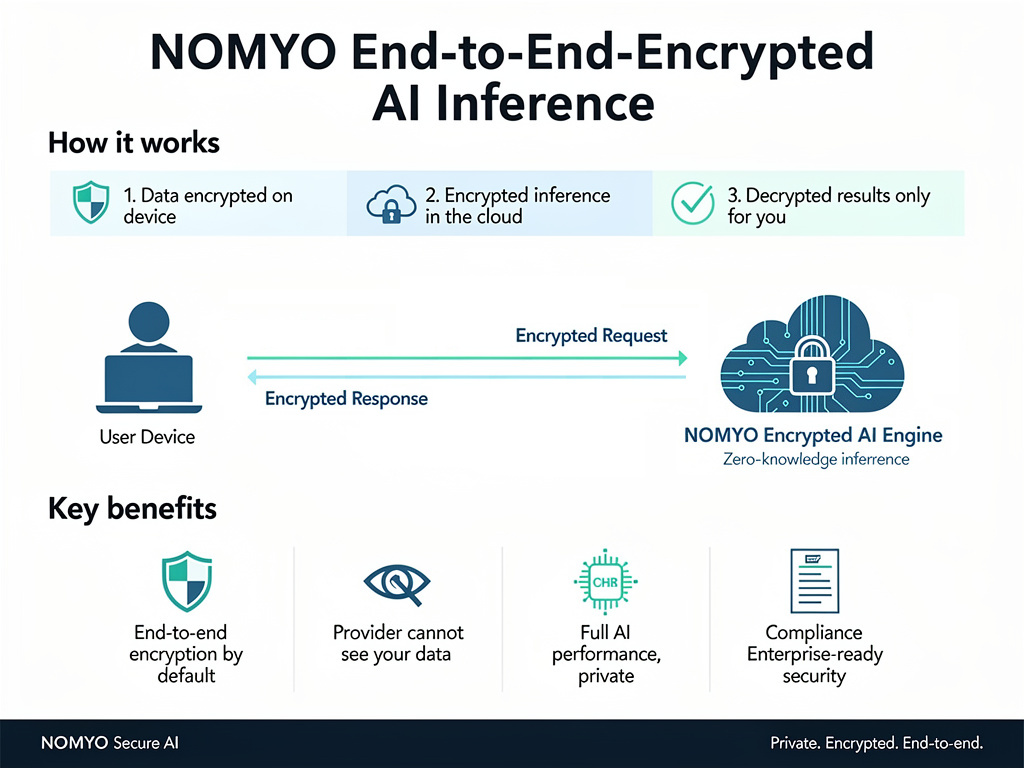
This documentation provides comprehensive information about using the NOMYO Secure Python Chat Client, a drop-in replacement for OpenAI's ChatCompletion API with end-to-end (E2E) encryption. To use this client library you need a paid subscribtion on NOMYO Inference.
Overview
The NOMYO Secure Client provides:
- End-to-end encryption using hybrid encryption (AES-256-GCM + RSA-OAEP)
- OpenAI API compatibility - same interface as OpenAI's ChatCompletion
- Secure memory protection - prevents plaintext from being swapped to disk
- Automatic key management - handles key generation and loading automatically
- HTTPS enforcement - secure communication by default
Quick Start
import asyncio
from nomyo import SecureChatCompletion

async def main():
    # Initialize client (defaults to https://api.nomyo.ai)
    client = SecureChatCompletion(api_key="your-api-key-here")

    # Simple chat completion
    response = await client.create(
        model="Qwen/Qwen3-0.6B",
        messages=[
            {"role": "user", "content": "Hello! How are you today?"}
        ],
        security_tier="standard", # optional: standard, high or maximum
        temperature=0.7
    )

    print(response['choices'][0]['message']['content'])

# Run the async function
asyncio.run(main())
Documentation Structure
- Installation - How to install and set up the client
- Getting Started - Quick start guide with examples
- API Reference - Complete API documentation
- Security Guide - Security features and best practices
- Examples - Advanced usage scenarios
- Models - Available OSS LLMs
- Rate Limits - API rate limits and errors
Key Features
- OpenAI Compatibility: Use the same API as OpenAI's ChatCompletion
- End-to-End Encryption: All prompts and responses are automatically encrypted/decrypted
- Secure Memory Protection: Prevents sensitive data from being swapped to disk
- Automatic Key Management: Keys are generated and loaded automatically
- Flexible Security Tiers: Control security levels for different data types