mirror of
https://github.com/trustgraph-ai/trustgraph.git
synced 2026-06-20 20:28:06 +02:00

177 lines
11 KiB
Markdown
177 lines
11 KiB
Markdown
|
|
<div align="center">
|
|
|
|
<img src="TG-fullname-logo.svg" width=100% />
|
|
|
|
[](https://pypi.org/project/trustgraph/)  
|
|
[](https://discord.gg/sQMwkRz5GX) [](https://deepwiki.com/trustgraph-ai/trustgraph)
|
|
|
|
[**Website**](https://trustgraph.ai) | [**Docs**](https://docs.trustgraph.ai) | [**YouTube**](https://www.youtube.com/@TrustGraphAI?sub_confirmation=1) | [**Configuration Terminal**](https://config-ui.demo.trustgraph.ai/) | [**Discord**](https://discord.gg/sQMwkRz5GX) | [**Blog**](https://blog.trustgraph.ai/subscribe)
|
|
|
|
<a href="https://trendshift.io/repositories/17291" target="_blank"><img src="https://trendshift.io/api/badge/repositories/17291" alt="trustgraph-ai%2Ftrustgraph | Trendshift" style="width: 250px; height: 55px;" width="250" height="55"/></a>
|
|
|
|
# Write context once. Run agents anywhere.
|
|
|
|
</div>
|
|
|
|
Stop rebuilding context from scratch. TrustGraph treats context as a holon: modular, independent Context Cores that power multi-tenant agent workflows, while naturally snapping together to form a unified, domain-wide intelligence layer. Version your context, share it across teams, and scale with full provenance aligned to semantic web standards like RDF, OWL, SKOS, and SHACL.
|
|
|
|
<div align="center">
|
|
|
|
## Context is a holon.
|
|
|
|
</div>
|
|
|
|
The philosopher Arthur Koestler coined the word [holon](https://en.wikipedia.org/wiki/Holon_(philosophy)) to describe something that is simultaneously a whole in itself and a part of something larger. A fact is whole. It is also part of a domain. A domain is whole. It is also part of an organization's knowledge. An organization's knowledge is whole. It is also part of every decision an agent makes.
|
|
|
|
AI agents break down because this structure is never built. Context gets shoved into flat text windows, scattered across vector stores, or hardwired into one-off prompts. Facts lose their relationships. Agents lose their grounding. Answers become hallucinated guesses.
|
|
|
|
## The Problem
|
|
|
|
When you build an AI agent today, you spend most of your time fighting context:
|
|
|
|
- **RAG retrieves fragments, not meaning**. Chunks of text have no structure. Relationships between facts are invisible. Your agent guesses at the connections.
|
|
|
|
- **Context is disposable**. What the agent learned in one session is gone in the next. There is no persistent, structured knowledge layer underneath.
|
|
|
|
- **Answers aren't traceable**. You can't explain why the agent said what it said, which means you can't trust it in production.
|
|
|
|
- **Knowledge can't be reused**. You rebuild the same context pipelines for every new project, every new agent, every new environment.
|
|
|
|
These aren't retrieval problems. They are structural problems. Context needs to be organized, versioned, and composable — exactly the way software infrastructure is.
|
|
|
|
## What TrustGraph Does
|
|
|
|
TrustGraph provides the full infrastructure layer underneath your agents: knowledge ingestion, structured storage, graph-grounded retrieval, agent orchestration, and inference — all in a single private, sovereign deployment.
|
|
|
|
At the core is a holonic system: a structured representation of your domain where entities, relationships, and evidence are first-class objects. Every agent query is grounded against these holons that marry symbolic graph structures and vector embeddings. Every answer carries provenance. Every fact is traceable.
|
|
|
|
On top of that sits Context Cores — portable, versioned bundles of domain knowledge you can build once and ship anywhere. Treat knowledge the way you treat code: build it, test it, version it, promote it to production, and roll it back when something breaks.
|
|
|
|
## Context Cores: Knowledge as a First-Class Artifact
|
|
|
|
A Context Core is the deployable unit of knowledge in TrustGraph. It packages everything an agent needs to reason reliably over a domain into a single, portable artifact.
|
|
|
|
What's inside a Context Core
|
|
- Ontology — your domain schema and entity mappings
|
|
- Holon — entities, relationships, and supporting evidence
|
|
- Embeddings — vector indexes for fast semantic entry-point lookup
|
|
- Provenance — where every fact came from, when, and how it was derived
|
|
- Retrieval policies — traversal rules, freshness controls, authority ranking
|
|
|
|
Context Cores decouple what agents know from how agents are deployed. Build once. Run in Docker locally, Kubernetes in production, or on any cloud. Pin a version. Roll back. Promote across environments. This is context engineering — and it works because knowledge is finally treated like the infrastructure it is.
|
|
|
|
## The Full Stack
|
|
TrustGraph is not a wrapper around a graph database. It is the complete backend for production agentic systems.
|
|
|
|
- **Holonic engine**: automated entity and relationship extraction, ontology-driven graph construction, graph-grounded retrieval for explainable outputs
|
|
- **Multi-model database**: tabular/relational, key-value, document, graph, vectors, images, video, and audio — all managed in Cassandra and S3-compatible Garage
|
|
- **Out-of-the-box RAG pipelines**: DocumentRAG, GraphRAG, and OntologyRAG ready to deploy
|
|
- **Fully agentic orchestration**: single or multi-agent, ReAct, Plan-then-Execute, Supervisor patterns, and MCP integration
|
|
- **3D Knowledge Explorer**: interactive graph visualization with BFS neighborhood extraction and edge pulse animation
|
|
- **Automated data ingest**: quick ingest with semantic similarity or ontology-structured precision retrieval
|
|
- **Run anywhere**: Docker/Podman locally, Kubernetes in the cloud
|
|
|
|
All major LLMs — Anthropic, Cohere, Gemini, Mistral, OpenAI, and more via API.
|
|
|
|
vLLM, Ollama, TGI, LM Studio, and Llamafiles for fully local inferencing.
|
|
|
|
## No API Keys Required
|
|
|
|
How many times have you cloned a repo and opened the `.env.example` to see the dozens of API keys for 3rd party dependencies needed to make the services work? There are only 3 things in TrustGraph that might need an API key:
|
|
|
|
- 3rd party LLM services like Anthropic, Cohere, Gemini, Mistral, OpenAI, etc.
|
|
- 3rd party OCR like Mistral OCR
|
|
- The API key *you set* for the TrustGraph API gateway
|
|
|
|
Everything else is included.
|
|
- [x] Managed Multi-model storage in [Cassandra](https://cassandra.apache.org/_/index.html)
|
|
- [x] Managed Vector embedding storage in [Qdrant](https://github.com/qdrant/qdrant)
|
|
- [x] Managed File and Object storage in [Garage](https://github.com/deuxfleurs-org/garage) (S3 compatible)
|
|
- [x] Managed High-speed Pub/Sub messaging fabric with [Pulsar](https://github.com/apache/pulsar) or [RabbitMQ](https://www.rabbitmq.com/)
|
|
- [x] Complete LLM inferencing stack for open LLMs with [vLLM](https://github.com/vllm-project/vllm), [TGI](https://github.com/huggingface/text-generation-inference), [Ollama](https://github.com/ollama/ollama), [LM Studio](https://github.com/lmstudio-ai), and [Llamafiles](https://github.com/mozilla-ai/llamafile)
|
|
|
|
## Quickstart
|
|
|
|
No need to clone the repo unless you are building from source. TrustGraph deploys as a set of Docker containers. Configure it on the command line in one step:
|
|
|
|
```
|
|
npx @trustgraph/config
|
|
```
|
|
|
|
The config process will generate an app config that can be run locally with Docker, Podman, or Minikube. The process will output:
|
|
- `deploy.zip` with either a `docker-compose.yaml` file for a Docker/Podman or `resources.yaml` for Kubernetes
|
|
- Deployment instructions as `INSTALLATION.md`
|
|
|
|
<p align="center">
|
|
<video src="https://github.com/user-attachments/assets/2978a6aa-4c9c-4d7c-ad02-8f3d01a1c602"
|
|
width="80%" controls></video>
|
|
</p>
|
|
|
|
For a browser based configuration, try the [Configuration Terminal](https://config-ui.demo.trustgraph.ai/).
|
|
|
|
## Watch What is a Holon?
|
|
|
|
[](https://www.youtube.com/watch?v=gZjlt5WcWB4)
|
|
|
|
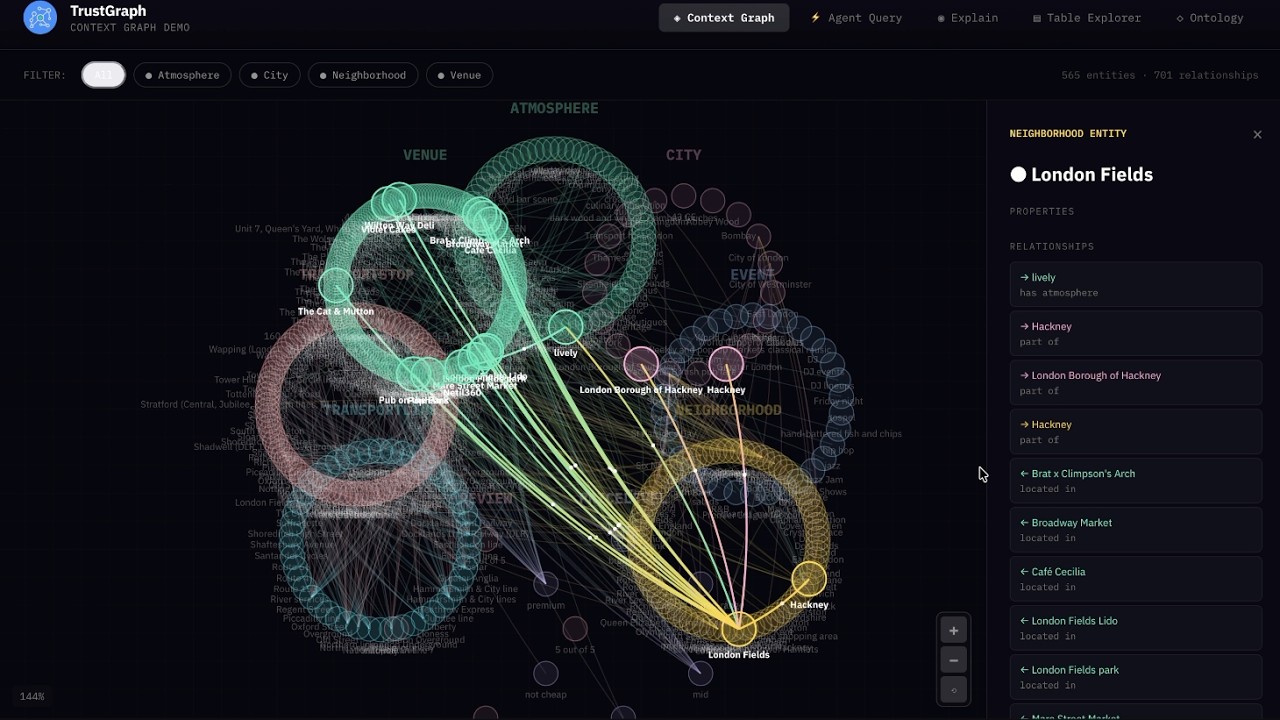
## Watch Holons in Action
|
|
|
|
[](https://www.youtube.com/watch?v=sWc7mkhITIo)
|
|
|
|
## Getting Started with TrustGraph
|
|
|
|
- [**Getting Started Guides**](https://docs.trustgraph.ai/getting-started)
|
|
- [**Developer APIs and CLI**](https://docs.trustgraph.ai/reference)
|
|
- [**Deployment Guides**](https://docs.trustgraph.ai/deployment)
|
|
|
|
## TrustGraph UI
|
|
|
|
<img width="1389" height="961" alt="Image" src="https://github.com/user-attachments/assets/35c9250d-0f01-40cb-9294-1ee8fd9a1b56" />
|
|
|
|
The UI provides tools for all major features of TrustGraph. The UI deploys on port `8888` by default.
|
|
|
|
- **Agent Console** — Query your agents directly with streaming responses and live explainability event tracking, so you can watch reasoning unfold in real time
|
|
- **GraphRAG View** — Interactive graph RAG queries with a visual explainability DAG and inline provenance display, making it easy to see exactly where answers came from
|
|
- **Context Explorer** — An interactive 3D context graph explorer with dynamic graph loading, BFS neighborhood extraction, edge pulse animation, and multiple navigation views
|
|
- **Document Ingestion** — A complete upload and submission workflow with page and chunk inspection and document structure browsing
|
|
- **Ontology Workbench** — A full ontology editor with class and property trees, OWL/XML and Turtle import/export with round-trip fidelity, circular dependency detection, and safe-delete confirmation dialogs
|
|
- **Schema Workbench** — Interactive schema management with list, create, edit, and delete operations including field and index management
|
|
- **Flow Management** — Flow creation and detail views with configurable parameters, temperature controls, and grouped storage layout
|
|
- **Workspace UX** — Workspace selection and management surfaced directly in the interface
|
|
- **Prompt Editor** — A dedicated prompt editing workflow
|
|
|
|
## TypeScript Library for UIs
|
|
|
|
There are 3 libraries for quick UI integration of TrustGraph services.
|
|
|
|
- [@trustgraph/client](https://www.npmjs.com/package/@trustgraph/client)
|
|
- [@trustgraph/react-state](https://www.npmjs.com/package/@trustgraph/react-state)
|
|
- [@trustgraph/react-provider](https://www.npmjs.com/package/@trustgraph/react-provider)
|
|
|
|
## Contributing
|
|
|
|
[Developer's Guide](https://docs.trustgraph.ai/guides/building/introduction.html)
|
|
|
|
## License
|
|
|
|
**TrustGraph** is licensed under [Apache 2.0](https://www.apache.org/licenses/LICENSE-2.0).
|
|
|
|
Copyright 2024-2026 TrustGraph
|
|
|
|
Licensed under the Apache License, Version 2.0 (the "License");
|
|
you may not use this file except in compliance with the License.
|
|
You may obtain a copy of the License at
|
|
|
|
http://www.apache.org/licenses/LICENSE-2.0
|
|
|
|
Unless required by applicable law or agreed to in writing, software
|
|
distributed under the License is distributed on an "AS IS" BASIS,
|
|
WITHOUT WARRANTIES OR CONDITIONS OF ANY KIND, either express or implied.
|
|
See the License for the specific language governing permissions and
|
|
limitations under the License.
|
|
|
|
## Support & Community
|
|
- Bug Reports & Feature Requests: [Discord](https://discord.gg/sQMwkRz5GX)
|
|
- Discussions & Questions: [Discord](https://discord.gg/sQMwkRz5GX)
|
|
- Documentation: [Docs](https://docs.trustgraph.ai/)
|