
7.9 KiB
invisible_playwright






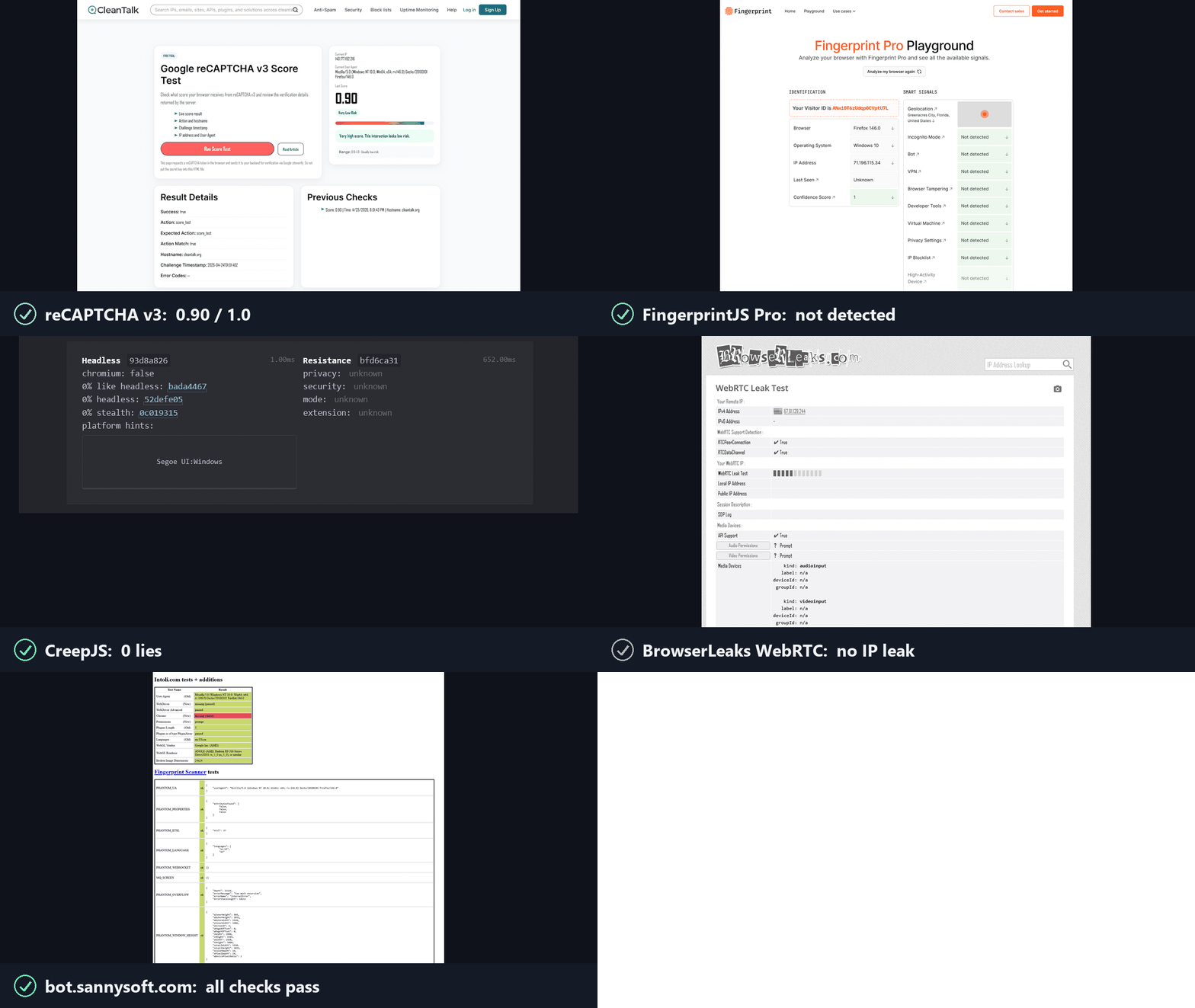
Stealth Firefox that passes every bot detection test. Drop-in Playwright replacement, fingerprint patched at the C++ level, not a JavaScript shim.
How it works
Most anti-detect browsers patch Chromium with injected JavaScript, which loses two ways:
- The patch is detectable. Every override leaves a seam, native
.toString(), descriptor flags, prototype order, exactly what CreepJS reads. - Chromium is suspect. Forks drop closed-source parts and lag real Chrome.
invisible_playwright avoids both by patching Firefox at the C++ level: nothing is injected into the page, so there is no seam to read, and the engine is Firefox, not a Chrome fork. The spoofed values come back through normal Gecko paths, true at the source across Navigator, screen, GPU/WebGL, Canvas, fonts, audio, WebRTC, timezone, DevTools and SOCKS5. The browser isn't hiding, so nothing can catch it hiding. Full per-layer breakdown in feder-cr/invisible_firefox.
Still seeing captchas or anti-bot? It's the proxy.
Once the browser is handled it stops being the variable. If you are still getting challenged, the tell is no longer the browser, it is the IP you come from. Around 90% of proxies are public: anyone can rent the same address, so it is already known and sits on the blocked-IP lists sites check. A perfect browser on a known IP still loses.
The fix is the clean 10%, residential IPs that aren't already known. For those we recommend sx.org, who filter for and serve only IPs that aren't already on those lists.
Install
pip install git+https://github.com/feder-cr/invisible_playwright.git
python -m invisible_playwright fetch      # one-time ~100 MB download, SHA256-verified
Supported platforms: Windows x86_64, Linux x86_64 / arm64, macOS arm64 / x86_64. On macOS the app is ad-hoc signed (not notarized): if Gatekeeper complains, clear the quarantine flag once with xattr -dr com.apple.quarantine on the cached Firefox.app.
Usage
Random fingerprint per session
100% Playwright-compatible - sync and async, all methods, zero API changes. If you already use Playwright, switching is two lines:
- from playwright.sync_api import sync_playwright
- with sync_playwright() as p:
-     browser = p.firefox.launch()
+ from invisible_playwright import InvisiblePlaywright
+ with InvisiblePlaywright() as browser:
Every session gets a distinct fingerprint (GPU, audio, fonts, screen, ~400 fields) and Bezier-curve mouse motion.
Sync
from invisible_playwright import InvisiblePlaywright

with InvisiblePlaywright(proxy={"server": "socks5://...", "username": "u", "password": "p"}) as browser:
    page = browser.new_page()
    page.goto("https://example.com")
    page.click("#submit")   # mouse arcs to the button on a Bezier curve
Async
from invisible_playwright.async_api import InvisiblePlaywright

async with InvisiblePlaywright(proxy={"server": "socks5://...", "username": "u", "password": "p"}) as browser:
    page = await browser.new_page()
    await page.goto("https://example.com")
    await page.click("#submit")
The browser object is a playwright.sync_api.Browser / playwright.async_api.Browser - every Playwright method works as-is.
Log the seed to replay a run:
sf = InvisiblePlaywright()
with sf as browser:
    print("seed =", sf.seed)
    # ...
Reproducible fingerprint
with InvisiblePlaywright(seed=42) as browser:
    ...   # same GPU, same canvas hash, same audio context, every run
Proxies
proxy = {
    "server": "socks5://gate.example.com:1080",
    "username": "user",
    "password": "pass",
}
with InvisiblePlaywright(proxy=proxy) as browser:
    ...
Schemes supported: socks5, socks4, http, https. DNS is routed through the proxy by default, no local leak.
Around 90% of proxies are public, so their IPs are already known and blocked. For the clean 10%, residential IPs that aren't already known, we recommend sx.org, who filter for and serve only IPs that aren't already on those lists.
Timezone
The browser timezone follows timezone=:
# default: timezone is auto-derived from the egress IP (proxy egress if a
# proxy is set, otherwise the host's own public IP)
with InvisiblePlaywright(proxy=proxy) as browser:
    ...

# explicit IANA zone always wins, the only way to force a specific zone
with InvisiblePlaywright(proxy=proxy, timezone="America/New_York") as browser:
    ...
Pinning specific fingerprint fields
By default everything comes from seed. To force specific values while the rest stays seed-derived:
with InvisiblePlaywright(
    seed=42,
    pin={
        "gpu.renderer": "ANGLE (NVIDIA, NVIDIA GeForce RTX 4090 Direct3D11)",
        "gpu.vendor":   "Google Inc. (NVIDIA)",
        "screen.width":  2560,
        "screen.height": 1440,
        "hardware.concurrency": 16,
    },
) as browser:
    ...
Full list of pinnable keys, how pinning interacts with the Bayesian sampler, and common patterns are in docs/pinning.md.
CLI
invisible_playwright fetch          # download the binary if missing
invisible_playwright fetch --force  # re-download even if cached
invisible_playwright path           # print the absolute path to the cached binary
invisible_playwright version        # wrapper and binary versions
invisible_playwright clear-cache    # remove all cached binaries
Related projects
Related projects that cover similar ground:
- arkenfox/user.js - Firefox privacy hardening via prefs. invisible_playwright patches C++ where prefs are insufficient.
- LibreWolf - Firefox fork with privacy defaults. LibreWolf ships a configured binary; invisible_playwright ships source patches + automation wrapper.
- Camoufox - open-source anti-detect Firefox. Patches a wider surface and ships its own fingerprint database; invisible_playwright uses a Bayesian sampler.
License
MIT - see LICENSE. The patched Firefox binary is distributed under the MPL-2.0 (Firefox upstream license). The C++ patches against mozilla-central that produce that binary are at feder-cr/invisible_firefox.
Disclaimer
This project is for educational purposes only. It is provided as-is, with no warranties. I take no responsibility for how it is used. Use it at your own risk and in compliance with the laws of your jurisdiction.