
## Agentic Orchestration Platform
[](https://pypi.org/project/trustgraph/) [](https://discord.gg/sQMwkRz5GX)
🚀 [Getting Started](https://trustgraph.ai/docs/getstarted) 📺 [YouTube](https://www.youtube.com/@TrustGraphAI?sub_confirmation=1) 🧠 [Cognitive Cores](https://github.com/trustgraph-ai/catalog/tree/master/v3) ⚙️ [API Docs](docs/apis/README.md) 🧑💻 [CLI Docs](https://trustgraph.ai/docs/running/cli) 💬 [Discord](https://discord.gg/sQMwkRz5GX) 📖 [Blog](https://blog.trustgraph.ai/subscribe)
TrustGraph empowers you to deploy reasoning AI Agents in minutes. Our Agentic Graph RAG platform allows you to leverage modular cognitive cores for complex reasoning and information retrieval, all within a scalable and reliable infrastructure. Forget lengthy development cycles – TrustGraph delivers instant reasoning.
## Key Features
- 📄 **Document Extraction**: Bulk ingest documents such as `.pdf`,`.txt`, and `.md`
- 🪓 **Adjustable Chunking**: Choose your chunking algorithm and parameters
- 🔁 **No-code LLM Integration**: **Anthropic**, **AWS Bedrock**, **AzureAI**, **AzureOpenAI**, **Cohere**, **Google AI Studio**, **Google VertexAI**, **Llamafiles**, **Ollama**, and **OpenAI**
- ☁️ **Cloud Deployments**: **AWS** and **Google Cloud**
- 📖 **Entity, Topic, and Relationship Knowledge Graphs**
- 🔢 **Mapped Vector Embeddings**
- ❔**No-code Graph RAG Queries**: Automatically perform a semantic similiarity search and subgraph extraction for the context of LLM generative responses
- 🧠 **Cognitive Cores**: Modular data sets with semantic relationships that can saved and quickly loaded on demand
- 🤖 **Agent Flow**: Define custom tools used by a ReAct style Agent Manager that fully controls the response flow including the ability to perform Graph RAG requests
- 📚 **Multiple Knowledge Graph Options**: Full integration with **Memgraph**, **FalkorDB**, **Neo4j**, or **Cassandra**
- 🧮 **Multiple VectorDB Options**: Full integration with **Pinecone**, **Qdrant**, or **Milvus**
- 🎛️ **Production-Grade** reliability, scalability, and accuracy
- 🔍 **Observability**: get insights into system performance with Prometheus and Grafana
- 🪴 **Customizable and Extensible**: Tailor for your data and use cases
- 🖥️ **Configuration Portal**: Build the `YAML` configuration with drop down menus and selectable parameters
- 🕵️ **Data Workbench**: Explore your data with a 3D semantic visualizer
## Quickstart Guide 🚀
- [Install the CLI](#install-the-trustgraph-cli)
- [Configuration Portal](#configuration-portal)
- [System Restarts](#system-restarts)
- [Data Workbench](#data-workbench)
- [Example Notebooks](#example-trustgraph-notebooks)
## Developer APIs and CLI
- [**REST API**](docs/apis/README.md#rest-apis)
- [**Websocket API**](docs/apis/README.md#websocket-api)
- [**Python SDK**](https://trustgraph.ai/docs/api/apistarted)
- [**TrustGraph CLI**](https://trustgraph.ai/docs/running/cli)
See the [API Developer's Guide](#api-documentation) for more information.
For users, **TrustGraph** has the following interfaces:
- [**Configuration Portal**](#configuration-portal)
- [**Data Workbench**](#data-workbench)
The `TrustGraph CLI` installs the commands for interacting with TrustGraph while running along with the Python SDK. The `Configuration Portal` enables customization of TrustGraph deployments prior to launching. The **REST API** can be accessed through port `8088` of the TrustGraph host machine with JSON request and response bodies.
### Install the TrustGraph CLI
```
pip3 install trustgraph-cli==0.20.9
```
> [!NOTE]
> The `TrustGraph CLI` version must match the desired `TrustGraph` release version.
## Configuration Portal
TrustGraph is endlessly customizable by editing the `YAML` launch files. The `Configuration Portal` provides a quick and intuitive tool for building a custom configuration that deploys with Docker, Podman, Minikube, or Google Cloud. There is a `Configuration Portal` for the both the lastest and stable `TrustGraph` releases.
- [**Configuration Portal** (Stable 0.20.9) 🚀](https://config-ui.demo.trustgraph.ai/)
- [**Configuration Portal** (Latest 0.20.11) 🚀](https://dev.config-ui.demo.trustgraph.ai/)
The `Configuration Portal` has 4 important sections:
- **Component Selection** ✅: Choose from the available deployment platforms, LLMs, graph store, VectorDB, chunking algorithm, chunking parameters, and LLM parameters
- **Customization** 🧰: Customize the prompts for the LLM System, Data Extraction Agents, and Agent Flow
- **Data Workbench** 🕵️: Add the **Data Workbench** to the configuration available on port `8888`
- **Finish Deployment** 🚀: Download the launch `YAML` files with deployment instructions
The `Configuration Portal` will generate the `YAML` files in `deploy.zip`. Once `deploy.zip` has been downloaded and unzipped, launching TrustGraph is as simple as navigating to the `deploy` directory and running:
```
docker compose up -d
```
> [!TIP]
> Docker is the recommended container orchestration platform for first getting started with TrustGraph.
When finished, shutting down TrustGraph is as simple as:
```
docker compose down -v
```
## System Restarts
The `-v` flag will destroy all data on shut down. To restart the system, it's necessary to keep the volumes. To keep the volumes, shut down without the `-v` flag:
```
docker compose down
```
With the volumes preserved, restarting the system is as simple as:
```
docker compose up -d
```
All data previously in TrustGraph will be saved and usable on restart.
## Data Workbench
If added to the build in the `Configuration Portal`, the `Data Workbench` will be available at port `8888`. The `Data Workbench` has the following capabilities:
- **Chat** 💬: Graph RAG queries in a chat interface
- **Search** 🔎: Semantic similarity search with cosine similarity scores
- **Explorer** 🕵️: See semantic relationships in a list structure
- **Visualizer** 🌐: Visualize semantic relationships in **3D**
- **Load** 📂: Directly load `.pdf`, `.txt`, or `.md` into the system with document metadata
## Example TrustGraph Notebooks
- [**REST API Notebooks**](https://github.com/trustgraph-ai/example-notebooks/tree/master/api-examples)
- [**Python SDK Notebooks**](https://github.com/trustgraph-ai/example-notebooks/tree/master/api-library)
## Prebuilt Configuration Files
TrustGraph `YAML` files are available [here](https://github.com/trustgraph-ai/trustgraph/releases). Download `deploy.zip` for the desired release version.
| Release Type | Release Version |
| ------------ | --------------- |
| Latest | [0.20.11](https://github.com/trustgraph-ai/trustgraph/releases/download/v0.20.11/deploy.zip) |
| Stable | [0.20.9](https://github.com/trustgraph-ai/trustgraph/releases/download/v0.20.9/deploy.zip) |
TrustGraph is fully containerized and is launched with a `YAML` configuration file. Unzipping the `deploy.zip` will add the `deploy` directory with the following subdirectories:
- `docker-compose`
- `minikube-k8s`
- `gcp-k8s`
> [!NOTE]
> As more integrations have been added, the number of possible combinations of configurations has become quite large. It is recommended to use the `Configuration Portal` to build your deployment configuration. Each directory contains `YAML` configuration files for the default component selections.
**Docker**:
```
docker compose -f up -d
```
**Kubernetes**:
```
kubectl apply -f
```
## Architecture
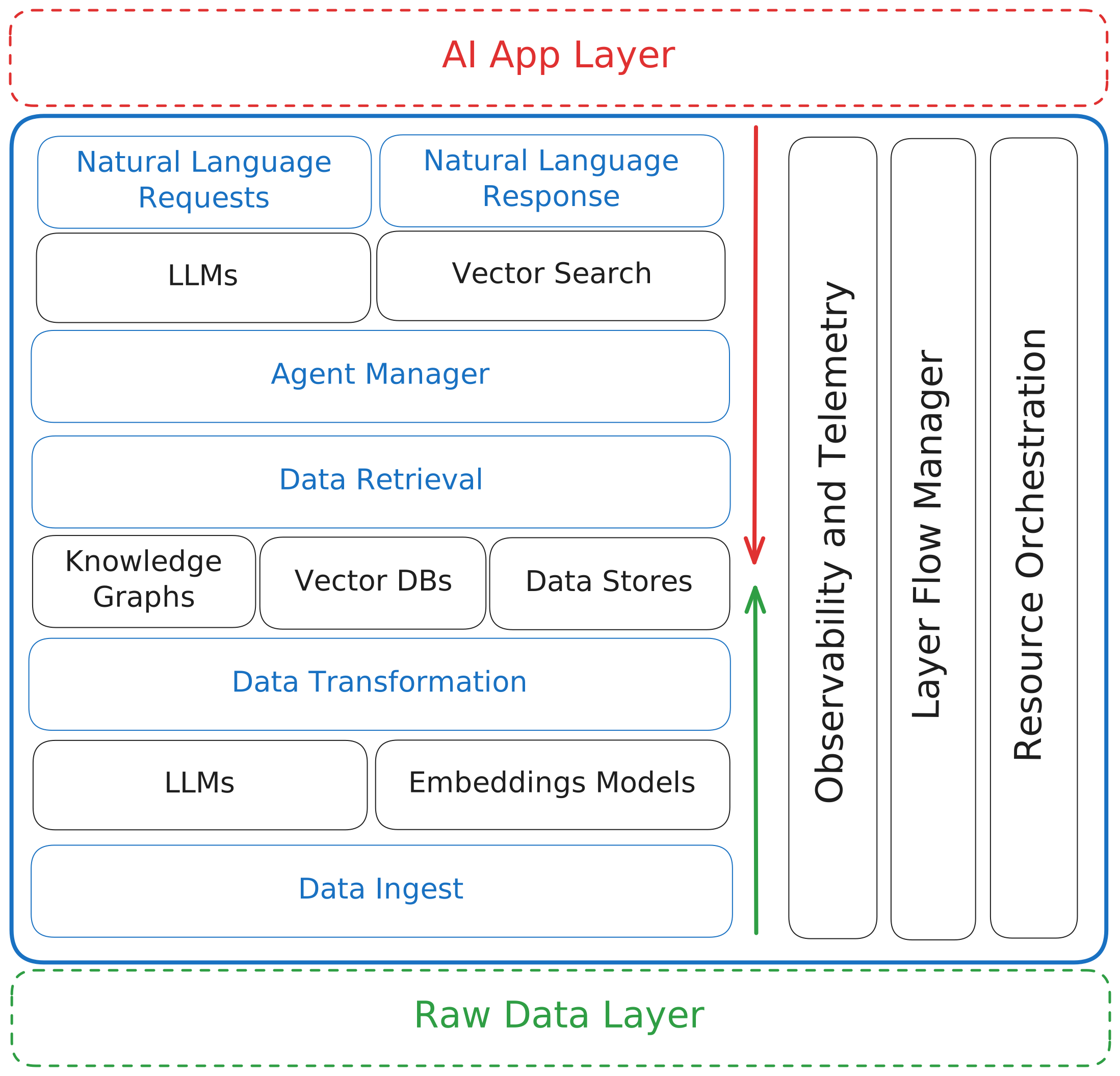
TrustGraph is designed to be modular to support as many LLMs and environments as possible. A natural fit for a modular architecture is to decompose functions into a set of modules connected through a pub/sub backbone. [Apache Pulsar](https://github.com/apache/pulsar/) serves as this pub/sub backbone. Pulsar acts as the data broker managing data processing queues connected to procesing modules.
### Pulsar Workflows
- For processing flows, Pulsar accepts the output of a processing module and queues it for input to the next subscribed module.
- For services such as LLMs and embeddings, Pulsar provides a client/server model. A Pulsar queue is used as the input to the service. When processed, the output is then delivered to a separate queue where a client subscriber can request that output.
## Data Extraction Agents
TrustGraph extracts knowledge documents to an ultra-dense knowledge graph using 3 automonous data extraction agents. These agents focus on individual elements needed to build the knowledge graph. The agents are:
- Topic Extraction Agent
- Entity Extraction Agent
- Relationship Extraction Agent
The agent prompts are built through templates, enabling customized data extraction agents for a specific use case. The data extraction agents are launched automatically with the loader commands.
PDF file:
```
tg-load-pdf
```
Text or Markdown file:
```
tg-load-text
```
## Graph RAG Queries
Once the knowledge graph and embeddings have been built or a cognitive core has been loaded, RAG queries are launched with a single line:
```
tg-invoke-graph-rag -q "What are the top 3 takeaways from the document?"
```
## Agent Flow
Invoking the Agent Flow will use a ReAct style approach the combines Graph RAG and text completion requests to think through a problem solution.
```
tg-invoke-agent -v -q "Write a blog post on the top 3 takeaways from the document."
```
> [!TIP]
> Adding `-v` to the agent request will return all of the agent manager's thoughts and observations that led to the final response.
## API Documentation
[Developing on TrustGraph using APIs](docs/apis/README.md)
## Deploy and Manage TrustGraph
[🚀🙏 Full Deployment Guide 🚀🙏](https://trustgraph.ai/docs/getstarted)
## TrustGraph Developer's Guide
[Developing for TrustGraph](docs/README.development.md)