 c1b1443fc2
- Replace ASCII-art pipeline with a proper rendered diagram (5 stages,
  color-coded, with iterate loop). Source: scripts/make_recipe_diagram.py.
- Update HF Hub URL to the actually-uploaded namespace (ranausmans, not
  ranausmanai — the latter is GitHub-only).
- Mark the adapter live: 192 MB, Apache-2.0.
7 KiB
TinyForge-Zero
Self-bootstrapping recipes for open base LLMs — no human-written training data.
A 14B open base model reaches 80% on HumanEval and 74.4% on HumanEval+ with only a Python interpreter as oracle and no human-curated training data, for under $5 of consumer-GPU compute. This repo contains the recipes, mined pairs, evaluation scripts, and adapters from the paper.
📄 Paper: How Far Can an Open Base Model Self-Improve? Recipes, Limits, and Test-Time Synergy — arXiv link forthcoming
📦 Companion to: ranausmanai/tinyforge (earlier exploratory experiments)
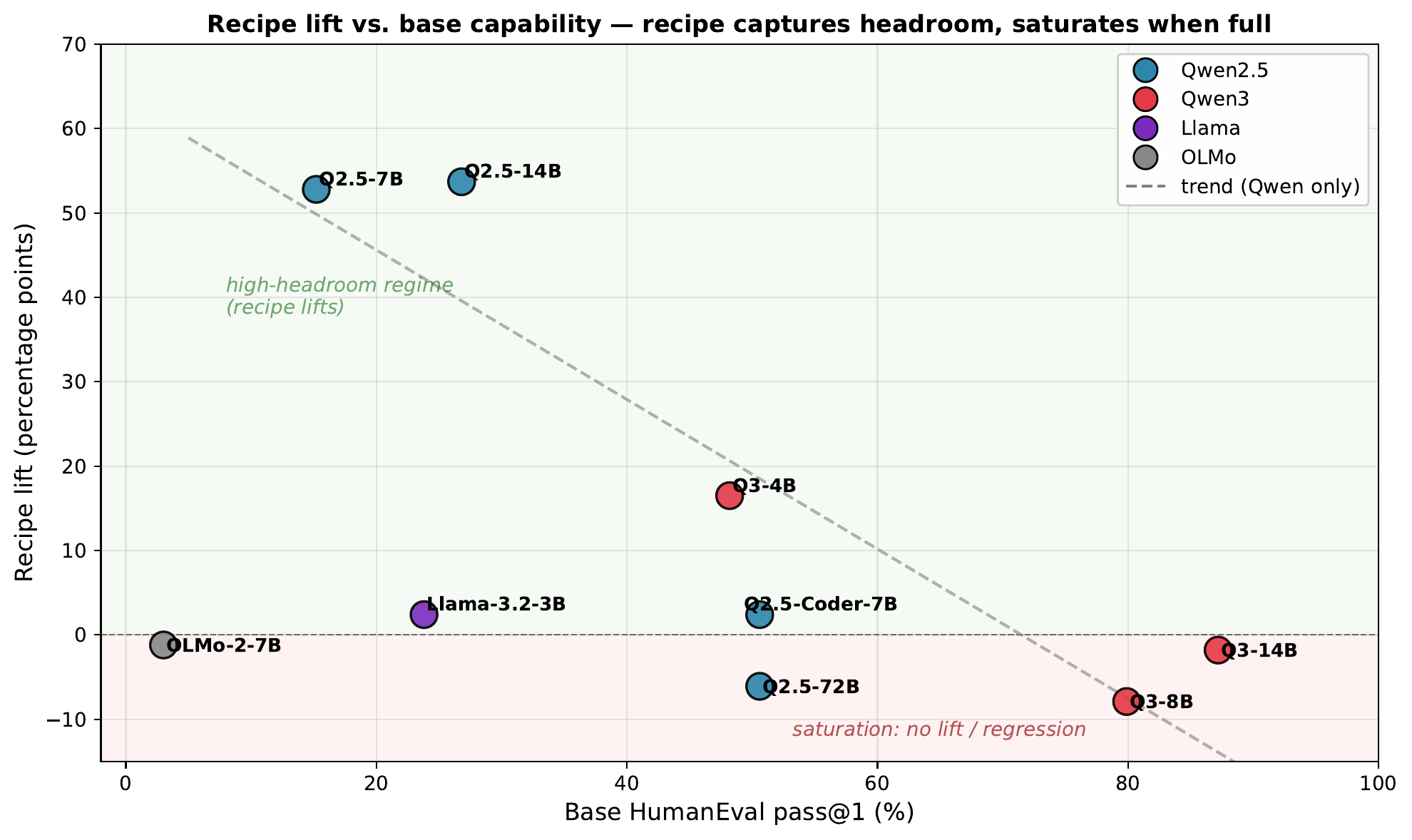
Headline results
| Model | Setting | Base | After recipe | Δ |
|---|---|---|---|---|
| Qwen2.5-14B-Base | HumanEval (chat-template) | 44/164 (26.8%) | 131/164 (79.9%) | +53.0pp |
| Qwen2.5-14B-Base | HumanEval+ | — | 122/164 (74.4%) | — |
| Qwen2.5-7B-Base | HumanEval (best seed) | 25/164 (15.2%) | 112/164 (68.3%) | +53.0pp |
| Qwen2.5-3B-Base | GSM8K (auto-difficulty curriculum) | 32/100 | 66/100 | +34pp |
| Random external pairs | HumanEval (control) | 25 | 25 | +0 |
All numbers from result.json files in this repo's accompanying paper data. Same adapter under the multi-pair run's eval format reads 132/164 (80.5%) — both round to 80%.
The recipe in one diagram
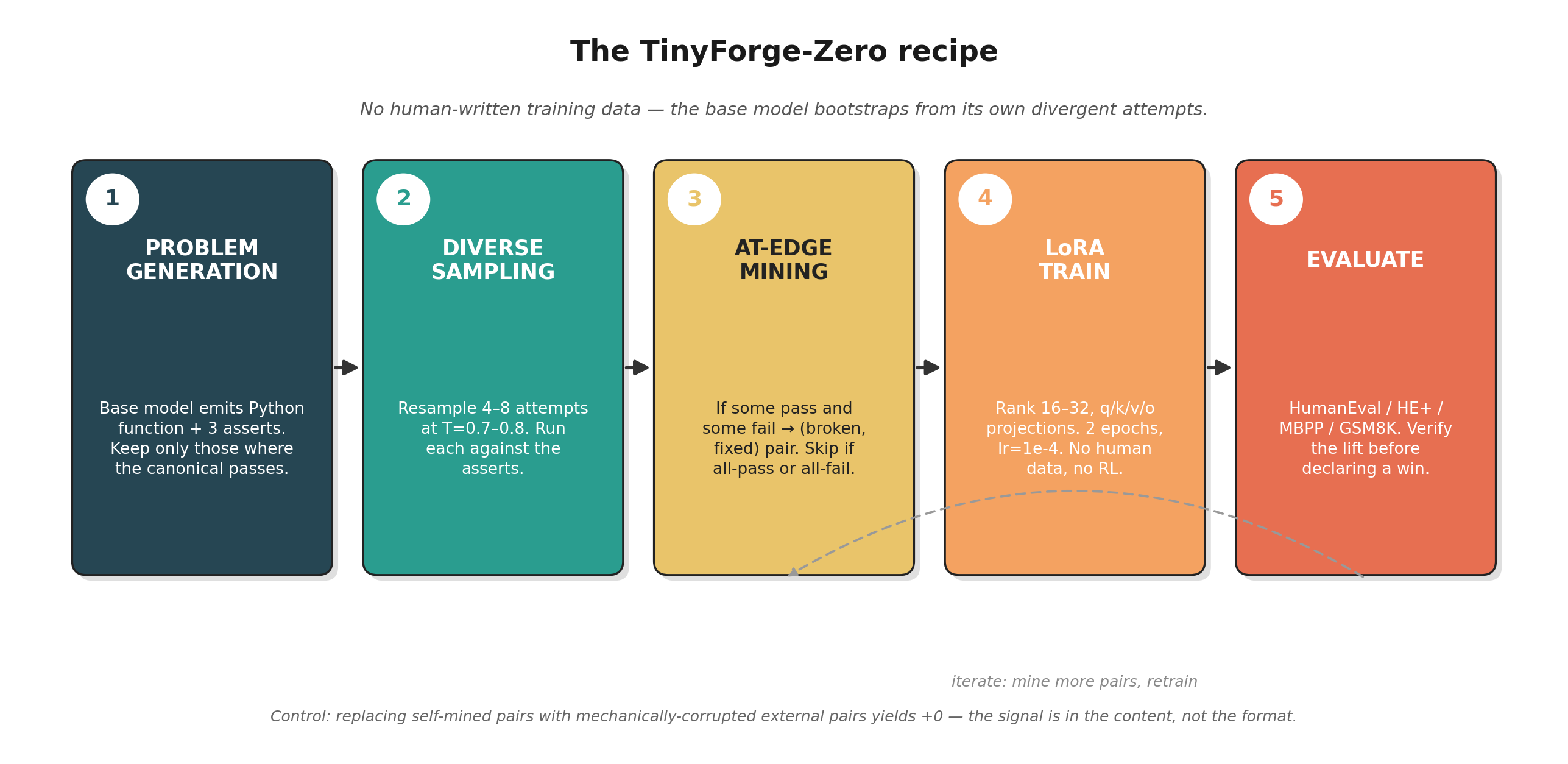
A control experiment — replacing the mined pairs with identically-formatted but randomly-corrupted external pairs — yields exactly +0. The signal is in the self-mined content, not the training-data format.
What's in this repo
tinyforge-zero/
├── recipe/
│   ├── train_on_pairs.py       # Fast-path: train LoRA on a released pairs.jsonl
│   ├── bootstrap.py            # Full-path: self-bootstrap pipeline (mining + train, 7B / 3B)
│   ├── multi_pair_14b.py       # Full-path: aggressive multi-pair variant → 80.5% on 14B
│   ├── curriculum_math.py      # Full-path: auto-difficulty curriculum for GSM8K
│   ├── eval_raw.py             # HumanEval / MBPP / GSM8K eval (vLLM, raw-completion)
│   ├── eval_plus.py            # HumanEval+ contamination-resistant eval
│   └── confirm.py              # Confirmation re-eval against base
├── data/
│   ├── pairs_7b_40.jsonl              # 40 self-mined pairs (Qwen2.5-7B-Base run)
│   ├── pairs_14b_multi_new60.jsonl    # 60 aggressive-mined pairs for 14B (+ warmup 40 → 100 total)
│   └── pairs_math_13.jsonl            # 13 curriculum-mined math pairs (Qwen2.5-3B-Base → GSM8K 32→66)
├── controls/
│   └── mbpp_corrupt_control.py # The +0 negative-control experiment
├── docs/
│   ├── scaling_chart.png       # Recipe lift vs base capability (paper Fig 1)
│   ├── fig1_headline.png       # Headline result chart
│   └── fig6_boundary.png       # Boundary conditions across 9 models
├── REPRODUCE.md                # Paper figure/table → exact command mapping
├── requirements.txt
└── LICENSE
Quickstart
# 1. Clone
git clone https://github.com/ranausmanai/tinyforge-zero.git
cd tinyforge-zero

# 2. Install (Python 3.10+, CUDA 12.1+, GPU with ≥40GB VRAM recommended)
pip install -r requirements.txt

# 3. Baseline the model (so you know the lift is real)
python recipe/eval_raw.py \
    --model Qwen/Qwen2.5-7B \
    --bench humaneval

# 4. Train on the released 40 mined pairs (~10 min on H100)
python recipe/train_on_pairs.py \
    --model Qwen/Qwen2.5-7B \
    --pairs data/pairs_7b_40.jsonl \
    --epochs 2 --lr 1e-4 --lora-rank 16 \
    --out adapter_7b --seed 13

# 5. Evaluate the trained adapter
python recipe/eval_raw.py \
    --model Qwen/Qwen2.5-7B \
    --adapter adapter_7b \
    --bench humaneval
Expected outcome: HumanEval moves from ~25/164 to ~95–112/164 (seed-dependent).
For the 14B → 80.5% run, use recipe/multi_pair_14b.py with both data/pairs_7b_40.jsonl (warmup) and data/pairs_14b_multi_new60.jsonl. See REPRODUCE.md for the exact command and expected hardware.
Boundary conditions (where the recipe fails)
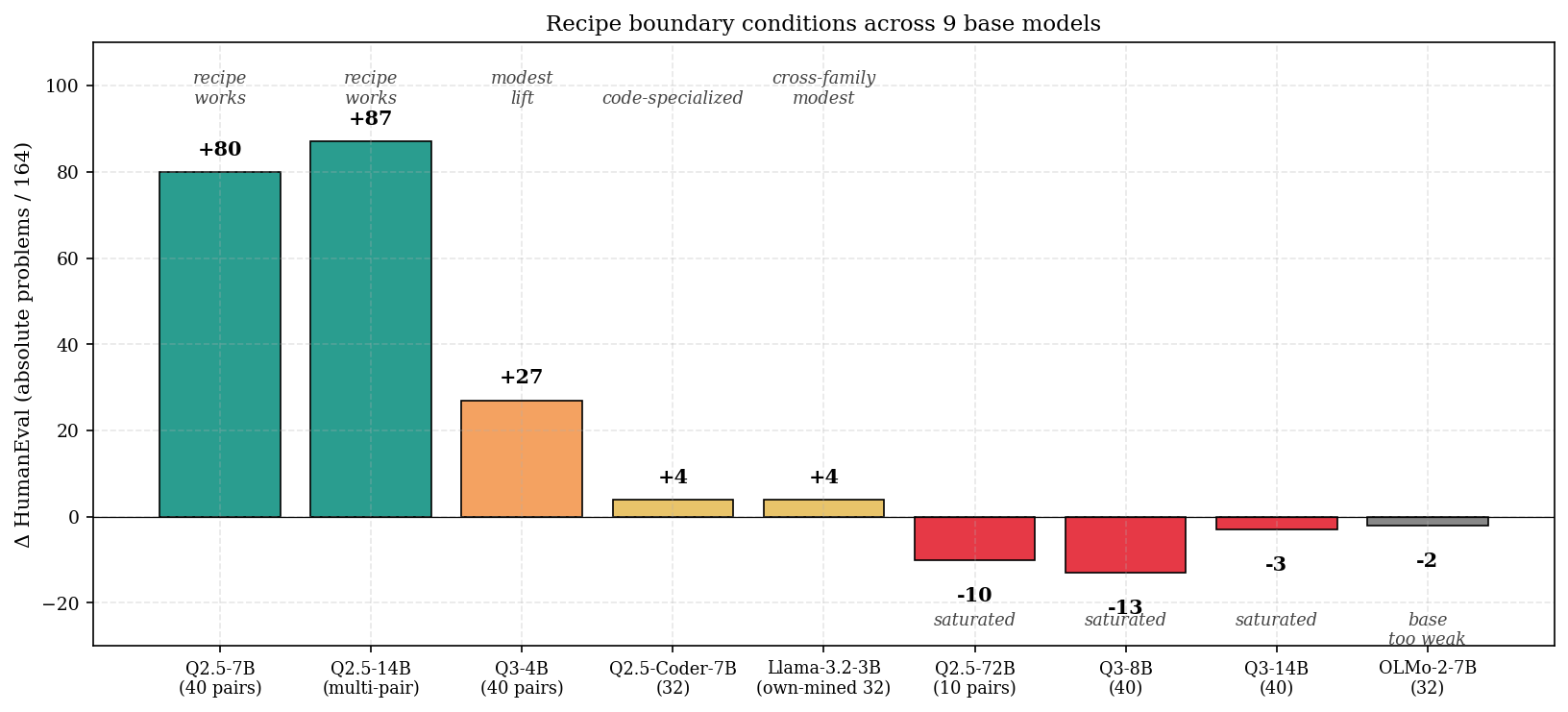
The recipe works under stated conditions. We document four failure modes:
- Saturation: Qwen3-8B/14B-Base and Qwen2.5-72B-Base have so little headroom on HumanEval that mining produces zero or negative lift.
- Distribution mismatch: Pairs mined on simple problems do not transfer to BigCodeBench-Hard (library code) or MATH-500 (competition math). Catastrophic when ignored — see the over-correction case (Qwen3-4B MATH-500 dropped 299 → 69).
- Base capability floor: OLMo-2-7B at 5/164 baseline produces too few "fix" attempts to mine from.
- Self-correction trained on wrong→fix only: model over-doubts and degrades on correct outputs. Mixing right→stays-right traces recovers it.
See the paper's §3 for measurements; the boundary chart above shows the recipe's lift across all 9 base models we tested.
Adapters
The LoRA adapter weights for the headline 14B run (the 80.5% adapter) are ~200 MB and are not committed to this repo. They live separately:
- Hugging Face Hub:
ranausmans/tinyforge-zero-qwen25-14b-lora— 192 MB, Apache-2.0 (inherits from Qwen2.5-14B base)
The adapter is a standard peft LoRA over Qwen/Qwen2.5-14B. Load with:
from peft import PeftModel
from transformers import AutoModelForCausalLM, AutoTokenizer

base = AutoModelForCausalLM.from_pretrained("Qwen/Qwen2.5-14B", torch_dtype="bfloat16")
model = PeftModel.from_pretrained(base, "ranausmans/tinyforge-zero-qwen25-14b-lora")
tok = AutoTokenizer.from_pretrained("Qwen/Qwen2.5-14B")
Hardware used in the paper
| Run | GPU | Time | Cost |
|---|---|---|---|
| Qwen2.5-7B 40-pair recipe | RTX 6000 Ada | ~30 min | <$1 |
| Qwen2.5-14B multi-pair (80.5%) | 1× H100 80GB | ~95 min | ~$3.50 |
| Qwen2.5-3B GSM8K curriculum | RTX 6000 Ada | ~30 min | <$1 |
| Full eval suite (9 models, HE+HE++MBPP) | 1× H100 | ~3 hrs | ~$8 |
All runs were on rented consumer/cloud GPUs (RunPod). Total spend documented in the paper was under $50.
Citation
@misc{usman2026tinyforgezero,
  title  = {How Far Can an Open Base Model Self-Improve?
            Recipes, Limits, and Test-Time Synergy},
  author = {Rana Usman},
  year   = {2026},
  eprint = {TBD},
  archivePrefix = {arXiv},
  primaryClass = {cs.AI}
}
License
MIT — see LICENSE. The mined pairs in data/ are derivatives of base-model outputs (Qwen2.5 family, Apache-2.0). Treat downstream redistribution accordingly.
Contact
- Issues / questions: GitHub Issues
- Email: usmanashrafrana@gmail.com