 a1db0e395a
Lets users connect their ChatGPT Plus/Pro subscription instead of pasting
an API key. Sign-in half only: the codex model client consumes the session
via getChatGPTAccessToken().

- PKCE OAuth against auth.openai.com using the official Codex CLI public
  client id (constants verified against the openai/codex sources); system
  browser + loopback callback server on the pre-registered fixed port
  127.0.0.1:1455, state validated, stale callbacks rejected
- token store (core): single config/chatgpt-auth.json holding non-secret
  display fields (email, accountId, expiresAt) plus the token material
  encrypted via the safeStorage cipher bridge (plaintext-with-marker
  fallback when no keychain, matching the GitHub token path); no token
  value ever written in the clear or logged
- getChatGPTAccessToken(): single-flight refresh within 5 min of expiry;
  refresh rejection (400/401) clears to a clean signed-out state and
  throws typed ChatGPTAuthRequiredError; 5xx/network kept as transient
- sign-out with best-effort token revocation
- IPC chatgpt:getStatus/signIn/cancelSignIn/signOut — raw tokens never
  cross to the renderer; real cancellation settles the in-flight attempt,
  frees the port, and a retry starts a fresh attempt (new PKCE/state)
- settings UI: ChatGPT Subscription section on the OpenAI card
  (sign in / waiting + cancel / connected as {email} + sign out) via a
  useChatGPT hook

Vitest covers the token store, single-flight refresh, and
transient-vs-terminal refresh handling.
|
||
|---|---|---|
| .github/workflows | ||
| apps | ||
| assets | ||
| .env.example | ||
| .gitattributes | ||
| .gitignore | ||
| build-electron.sh | ||
| CLAUDE.md | ||
| docker-compose.yml | ||
| Dockerfile.qdrant | ||
| google-setup.md | ||
| LICENSE | ||
| README.md | ||
| start.sh | ||

Rowboat
A desktop AI coworker with a memory of your work and built-in surfaces to act on it.




Rowboat indexes your work into a living knowledge graph and uses that to get work done on your machine. It includes work surfaces for collaborating with AI: email client, notes, browser, code mode, meeting note taker, and workspaces for different projects.
Download latest for Mac/Windows/Linux: Download

Demo - apps to code · Demo - knowledge graph
⭐ If you find Rowboat useful, please star the repo. It helps more people find it.
Overview
BrainRowboat indexes email, meetings, slack and assistant conversations into a living Obsidian-style backlinked knowledge graph. |

|
|
|

|
Background agentsYou can set up background agents that run on events like new email or on schedule like every day at 8am. They can connect to tools, search the web, use the browser and write code using Claude Code or Codex. |

|
Built-in BrowserRowboat includes a browser that lets you and assistant collaborate on web tasks. Because its isolated from your main browser, you can log in only to the accounts that want the assistant to access. |

|
Meeting NotesA local meeting note-taker that taps into mic & speaker, produces live transcript and summarizes the meeting in a markdown file and updates the knowledge graph. |

|
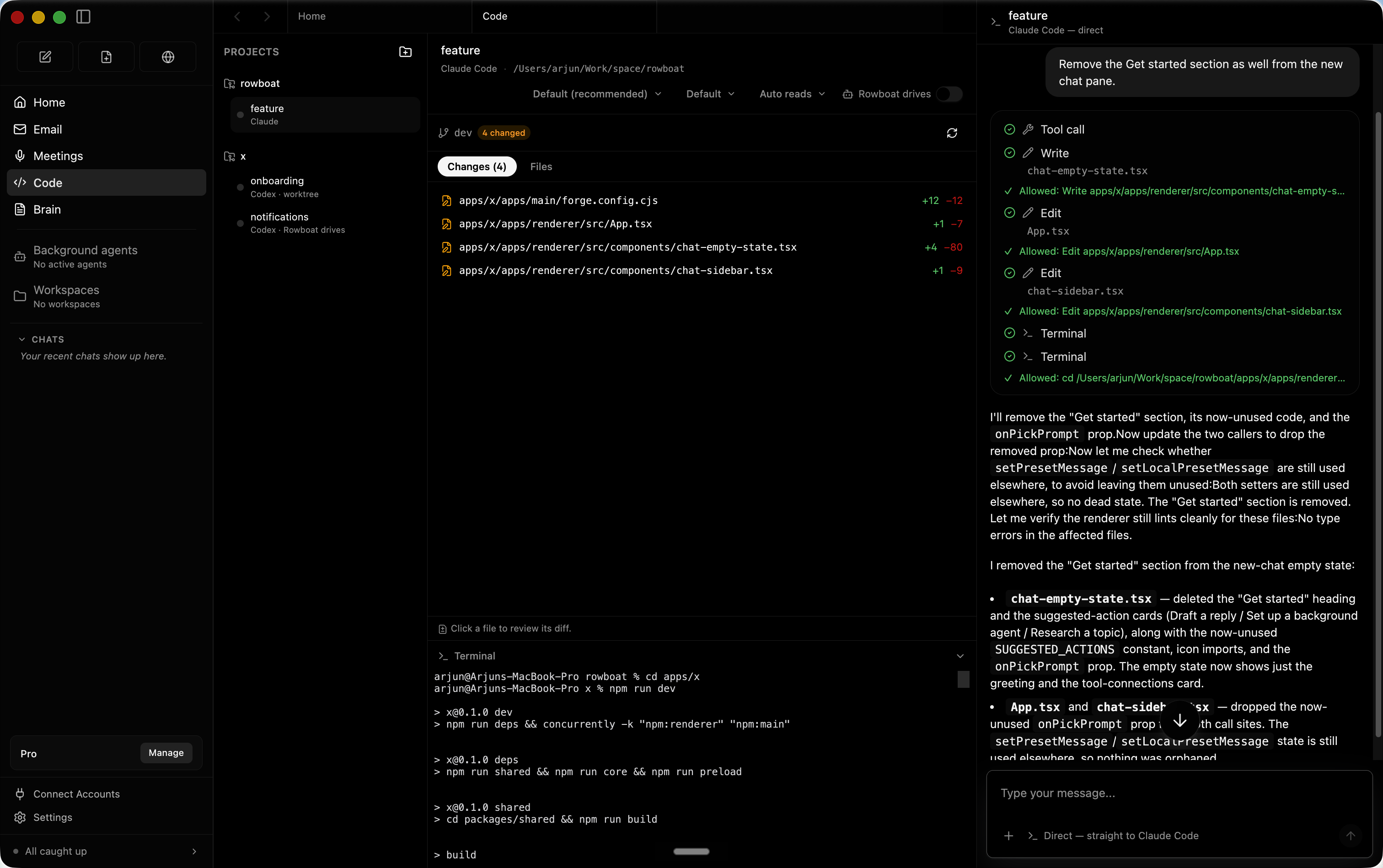
Code ModeCode mode lets you spin up parallel coding agents with Claude Code or Codex, and have Rowboat drive them with all the work context where needed. |
|
AppsYou can bulild your own work surfaces inside Rowboat — they get acess to all the tools and integrations, and you can share them with other people. |

|
IntegrationsIncludes one-click integrations to most popular products. |

|
Installation
Download latest for Mac/Windows/Linux: Download
All release files: https://github.com/rowboatlabs/rowboat/releases/latest
Google setup
To connect Google services (Gmail, Calendar, and Drive), follow Google setup.
Voice input
To enable voice input and voice notes (optional), add a Deepgram API key in ~/.rowboat/config/deepgram.json
Voice output
To enable voice output (optional), add an ElevenLabs API key in ~/.rowboat/config/elevenlabs.json
Web search
To use Exa research search (optional), add the Exa API key in ~/.rowboat/config/exa-search.json
External tools
To enable external tools (optional), you can add any MCP server or use Composio tools by adding an API key in ~/.rowboat/config/composio.json
All API key files use the same format:
{
  "apiKey": "<key>"
}
How it’s different
Most AI tools reconstruct context on demand by searching transcripts or documents.
Rowboat maintains long-lived knowledge instead:
- context accumulates over time
- relationships are explicit and inspectable
- notes are editable by you, not hidden inside a model
- everything lives on your machine as plain Markdown
The result is memory that compounds, rather than retrieval that starts cold every time.
Bring your own model
Rowboat works with the model setup you prefer:
- Local models via Ollama or LM Studio
- Hosted models (bring your own API key/provider)
- Swap models anytime — your data stays in your local Markdown vault
Extend Rowboat with tools (MCP)
Rowboat can connect to external tools and services via Model Context Protocol (MCP). That means you can plug in (for example) search, databases, CRMs, support tools, and automations - or your own internal tools.
Examples: Exa (web search), Twitter/X, ElevenLabs (voice), Slack, Linear/Jira, GitHub, and more.
Local-first by design
- All data is stored locally as plain Markdown
- No proprietary formats or hosted lock-in
- You can inspect, edit, back up, or delete everything at any time