 15d484980d
* fix(x): show chat timestamps in the user's local timezone The per-message "Current date and time" context was built with toISOString(), giving the model a UTC time frame with no zone. It then quoted email Date: headers (sent in +0000) in UTC — an email shown as 1:06 PM IST in the inbox was described as 7:36 AM in chat. Use local wall-clock via toLocaleString with an explicit timeZoneName and the IANA zone (matching what the legacy engine already did) so the model converts offset-bearing timestamps to local time. * fix(x): convert email timestamps to local time for the assistant The "now" fix gave the model a local time frame, but email dates still reached it as raw RFC 2822 Date: headers (marketing mail is sent in +0000), so it kept quoting them in UTC — a 1:06 PM IST email described as 7:36 AM in chat. Add formatEmailDateLocal() and apply it at the three model-facing serialization points: the read-view email tool, the thread-summary line, and the gmail-sync knowledge markdown (**Date:**). The structured date field on snapshots/messages is left raw, since the renderer parses it with new Date() and formats it client-side. * fix(x): generalize local-time formatting for model-facing timestamps Move formatEmailDateLocal out of sync_gmail into a shared formatTimestampForModel() util — email is just the first source of external timestamps; Slack/calendar serialization can now reuse the same one-line call instead of growing per-source formatters. Also add a system-prompt instruction to always express times in the user's local timezone, as a fallback for raw dates inside email bodies, web content, and third-party tool output that pre-conversion can't reach. Co-Authored-By: Claude Fable 5 <noreply@anthropic.com> --------- Co-authored-by: Claude Fable 5 <noreply@anthropic.com> |
||
|---|---|---|
| .github/workflows | ||
| apps | ||
| assets | ||
| .env.example | ||
| .gitattributes | ||
| .gitignore | ||
| build-electron.sh | ||
| CLAUDE.md | ||
| docker-compose.yml | ||
| Dockerfile.qdrant | ||
| google-setup.md | ||
| LICENSE | ||
| README.md | ||
| start.sh | ||

Rowboat
A desktop AI coworker with a memory of your work and built-in surfaces to act on it.




Rowboat indexes your work into a living knowledge graph and uses that to get work done on your machine. It includes work surfaces for collaborating with AI: email client, notes, browser, code mode, meeting note taker, and workspaces for different projects.
Download latest for Mac/Windows/Linux: Download

Demo - apps to code · Demo - knowledge graph
⭐ If you find Rowboat useful, please star the repo. It helps more people find it.
Overview
BrainRowboat indexes email, meetings, slack and assistant conversations into a living Obsidian-style backlinked knowledge graph. |

|
|
|

|
Background agentsYou can set up background agents that run on events like new email or on schedule like every day at 8am. They can connect to tools, search the web, use the browser and write code using Claude Code or Codex. |

|
Built-in BrowserRowboat includes a browser that lets you and assistant collaborate on web tasks. Because it's isolated from your main browser, you can log in only to the accounts that want the assistant to access. |

|
Meeting NotesA local meeting note-taker that taps into mic & speaker, produces live transcript and summarizes the meeting in a markdown file and updates the knowledge graph. |

|
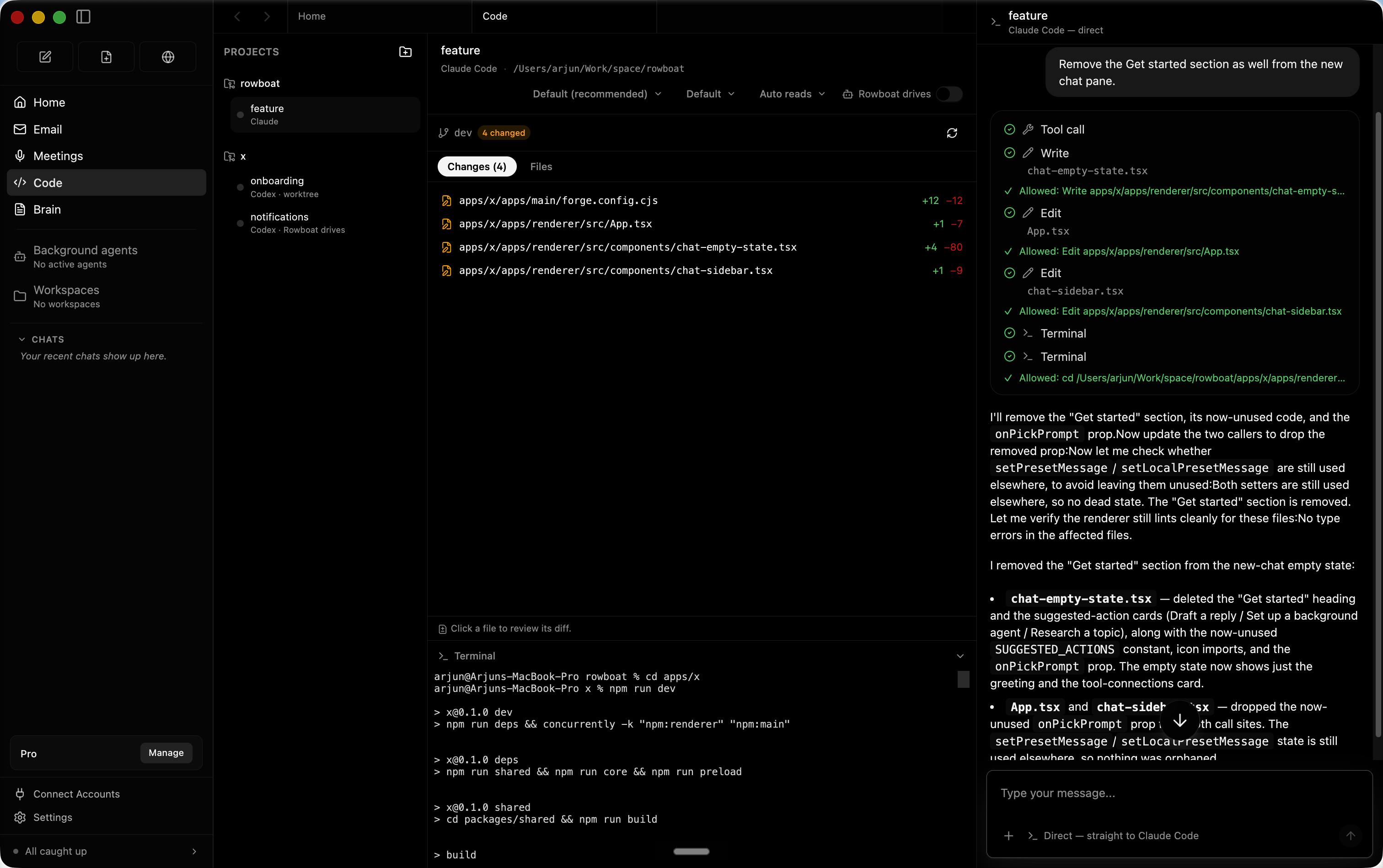
Code ModeCode mode lets you spin up parallel coding agents with Claude Code or Codex, and have Rowboat drive them with all the work context where needed. |
|
AppsYou can build your own work surfaces inside Rowboat — they get access to all the tools and integrations, and you can share them with other people. |

|
IntegrationsIncludes one-click integrations to most popular products. |

|
Installation
Download latest for Mac/Windows/Linux: Download
All release files: https://github.com/rowboatlabs/rowboat/releases/latest
Google setup
To connect Google services (Gmail, Calendar, and Drive), follow Google setup.
Voice input
To enable voice input and voice notes (optional), add a Deepgram API key in ~/.rowboat/config/deepgram.json
Voice output
To enable voice output (optional), add an ElevenLabs API key in ~/.rowboat/config/elevenlabs.json
Web search
To use Exa research search (optional), add the Exa API key in ~/.rowboat/config/exa-search.json
External tools
To enable external tools (optional), you can add any MCP server or use Composio tools by adding an API key in ~/.rowboat/config/composio.json
All API key files use the same format:
{
  "apiKey": "<key>"
}
How it’s different
Most AI tools reconstruct context on demand by searching transcripts or documents.
Rowboat maintains long-lived knowledge instead:
- context accumulates over time
- relationships are explicit and inspectable
- notes are editable by you, not hidden inside a model
- everything lives on your machine as plain Markdown
The result is memory that compounds, rather than retrieval that starts cold every time.
Bring your own model
Rowboat works with the model setup you prefer:
- Local models via Ollama or LM Studio
- Hosted models (bring your own API key/provider)
- Swap models anytime — your data stays in your local Markdown vault
Extend Rowboat with tools (MCP)
Rowboat can connect to external tools and services via Model Context Protocol (MCP). That means you can plug in (for example) search, databases, CRMs, support tools, and automations - or your own internal tools.
Examples: Exa (web search), Twitter/X, ElevenLabs (voice), Slack, Linear/Jira, GitHub, and more.
Local-first by design
- All data is stored locally as plain Markdown
- No proprietary formats or hosted lock-in
- You can inspect, edit, back up, or delete everything at any time