rowboat/google-setup.md

157 lines
3.9 KiB
Markdown
Raw Permalink Normal View History

# Connecting Google to Rowboat
feat(oauth): switch Google OAuth from PKCE to authorization code flow with client secret Previously, the Google OAuth integration used a PKCE-only flow (no client secret). This switches to a standard authorization code flow where the user provides both a Client ID and Client Secret from a "Web application" type OAuth client in Google Cloud Console. PKCE is retained alongside the secret for defense in depth. Key changes: - oauth-client.ts: discoverConfiguration() and createStaticConfiguration() now accept an optional clientSecret param. When provided, uses ClientSecretPost instead of None() for client authentication. - oauth-handler.ts: connectProvider() takes a credentials object ({clientId, clientSecret}) instead of a bare clientId. Removed eager persistence of clientId before flow completion — credentials are now only saved after successful token exchange. Renamed resolveClientId to resolveClientCredentials to return both values from a single repo read. - google-client-factory.ts: same resolveClientId → resolveCredentials rename. Passes clientSecret to OAuth2Client constructor and discoverConfiguration for token refresh. - repo.ts: added clientSecret to ProviderConnectionSchema. Not exposed to renderer via ClientFacingConfigSchema (stays main-process only). - IPC: added clientSecret to oauth:connect request schema. Handler builds a credentials object and passes it through. - UI: GoogleClientIdModal now collects both Client ID and Client Secret (password field). Always shown on connect — no in-memory credential caching. Renamed google-client-id-store to google-credentials-store with a unified {clientId, clientSecret} object. - google-setup.md: updated to instruct users to create a "Web application" type OAuth client (instead of UWP), add the localhost redirect URI, and copy both Client ID and Client Secret. Added credentials modal screenshot. Co-Authored-By: Claude Opus 4.6 (1M context) <noreply@anthropic.com>
2026-04-10 00:42:59 +05:30
Rowboat requires Google OAuth credentials (Client ID and Client Secret) to connect to Gmail, Calendar, and Drive. Follow the steps below to generate them.
---
## 1⃣ Open Google Cloud Console
Go to:
https://console.cloud.google.com/
Make sure you're logged into the Google account you want to use.
---
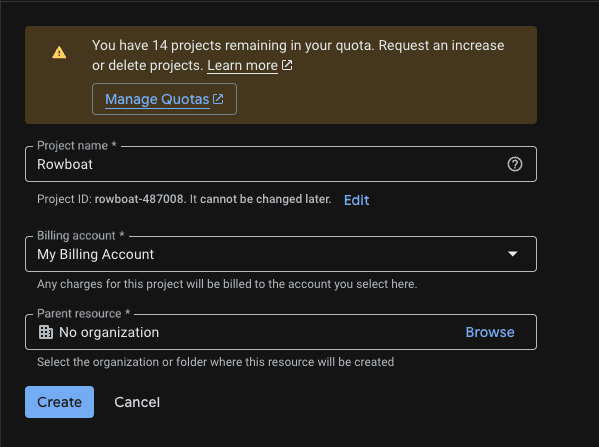
## 2⃣ Create a New Project
Go to:
https://console.cloud.google.com/projectcreate
- Click **Create Project**
- Give it a name (e.g. `Rowboat Integration`)
- Click **Create**
Once created, make sure the new project is selected in the top project dropdown.
![Select the new project in the dropdown](https://raw.githubusercontent.com/rowboatlabs/rowboat/main/apps/docs/docs/img/google-setup/01-select-project-dropdown.png)
---
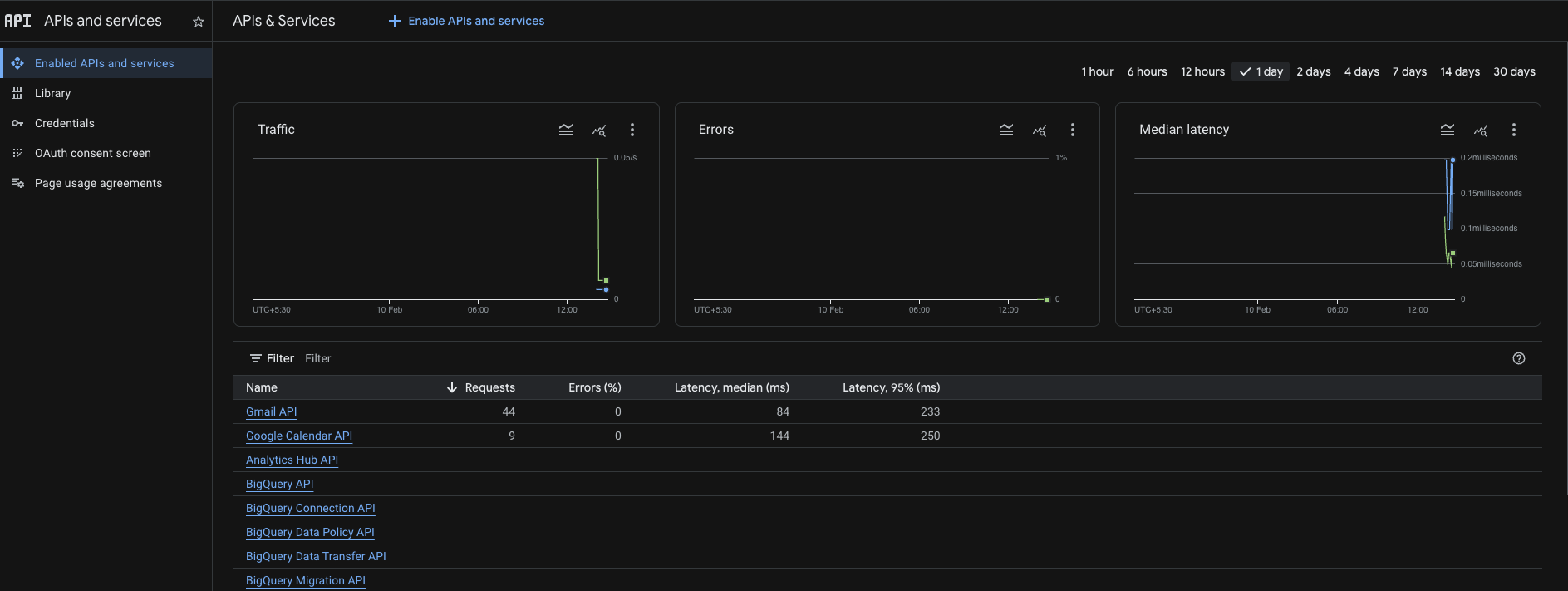
## 3⃣ Enable Required APIs
Enable the following APIs for your project:
- Gmail API
https://console.cloud.google.com/apis/api/gmail.googleapis.com
- Google Calendar API
https://console.cloud.google.com/apis/api/calendar-json.googleapis.com
- Google Drive API
https://console.cloud.google.com/apis/api/drive.googleapis.com
For each API:
- Click **Enable**
![Enable the API](https://raw.githubusercontent.com/rowboatlabs/rowboat/main/apps/docs/docs/img/google-setup/02-enable-api.png)
---
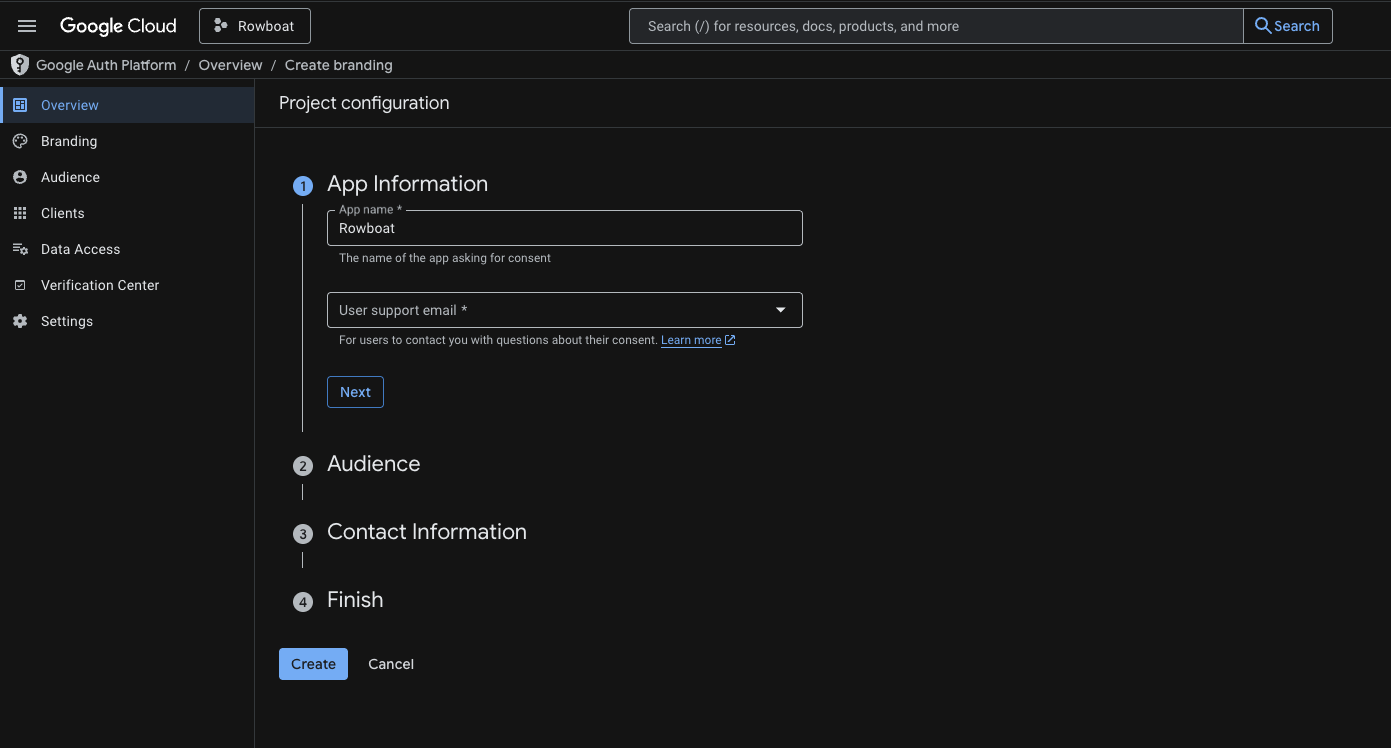
## 4⃣ Configure OAuth Consent Screen
Go to:
https://console.cloud.google.com/auth/branding
### App Information
- App name: (e.g. `Rowboat`)
- User support email: Your email
### Audience
- Choose **External**
### Contact Information
- Add your email address
Click **Save and Continue** through the remaining steps.
You do NOT need to publish the app — keeping it in **Testing** mode is fine.
![OAuth consent screen](https://raw.githubusercontent.com/rowboatlabs/rowboat/main/apps/docs/docs/img/google-setup/03-oauth-consent-screen.png)
---
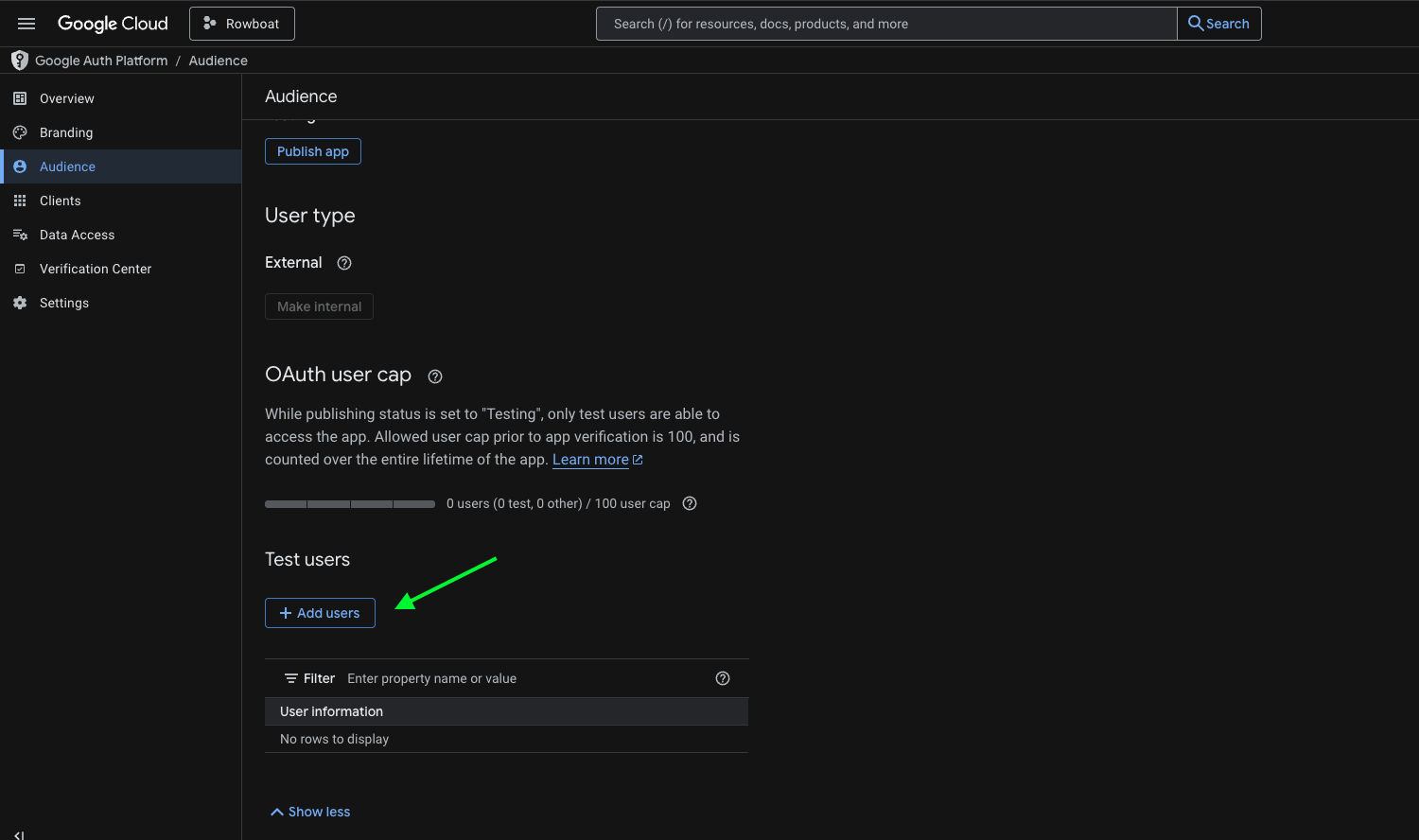
## 5⃣ Add Test Users
If your app is in Testing mode, you must add users manually.
Go to:
https://console.cloud.google.com/auth/audience
Under **Test Users**:
- Click **Add Users**
- Add the email address you plan to connect with Rowboat
Save changes.
![Add test users](https://raw.githubusercontent.com/rowboatlabs/rowboat/main/apps/docs/docs/img/google-setup/04-add-test-users.png)
---
## 6⃣ Create OAuth Client ID
Go to:
https://console.cloud.google.com/auth/clients
Click **Create Credentials → OAuth Client ID**
### Application Type
Select:
feat(oauth): switch Google OAuth from PKCE to authorization code flow with client secret Previously, the Google OAuth integration used a PKCE-only flow (no client secret). This switches to a standard authorization code flow where the user provides both a Client ID and Client Secret from a "Web application" type OAuth client in Google Cloud Console. PKCE is retained alongside the secret for defense in depth. Key changes: - oauth-client.ts: discoverConfiguration() and createStaticConfiguration() now accept an optional clientSecret param. When provided, uses ClientSecretPost instead of None() for client authentication. - oauth-handler.ts: connectProvider() takes a credentials object ({clientId, clientSecret}) instead of a bare clientId. Removed eager persistence of clientId before flow completion — credentials are now only saved after successful token exchange. Renamed resolveClientId to resolveClientCredentials to return both values from a single repo read. - google-client-factory.ts: same resolveClientId → resolveCredentials rename. Passes clientSecret to OAuth2Client constructor and discoverConfiguration for token refresh. - repo.ts: added clientSecret to ProviderConnectionSchema. Not exposed to renderer via ClientFacingConfigSchema (stays main-process only). - IPC: added clientSecret to oauth:connect request schema. Handler builds a credentials object and passes it through. - UI: GoogleClientIdModal now collects both Client ID and Client Secret (password field). Always shown on connect — no in-memory credential caching. Renamed google-client-id-store to google-credentials-store with a unified {clientId, clientSecret} object. - google-setup.md: updated to instruct users to create a "Web application" type OAuth client (instead of UWP), add the localhost redirect URI, and copy both Client ID and Client Secret. Added credentials modal screenshot. Co-Authored-By: Claude Opus 4.6 (1M context) <noreply@anthropic.com>
2026-04-10 00:42:59 +05:30
**Web application**
- Name it anything (e.g. `Rowboat Desktop`)
feat(oauth): switch Google OAuth from PKCE to authorization code flow with client secret Previously, the Google OAuth integration used a PKCE-only flow (no client secret). This switches to a standard authorization code flow where the user provides both a Client ID and Client Secret from a "Web application" type OAuth client in Google Cloud Console. PKCE is retained alongside the secret for defense in depth. Key changes: - oauth-client.ts: discoverConfiguration() and createStaticConfiguration() now accept an optional clientSecret param. When provided, uses ClientSecretPost instead of None() for client authentication. - oauth-handler.ts: connectProvider() takes a credentials object ({clientId, clientSecret}) instead of a bare clientId. Removed eager persistence of clientId before flow completion — credentials are now only saved after successful token exchange. Renamed resolveClientId to resolveClientCredentials to return both values from a single repo read. - google-client-factory.ts: same resolveClientId → resolveCredentials rename. Passes clientSecret to OAuth2Client constructor and discoverConfiguration for token refresh. - repo.ts: added clientSecret to ProviderConnectionSchema. Not exposed to renderer via ClientFacingConfigSchema (stays main-process only). - IPC: added clientSecret to oauth:connect request schema. Handler builds a credentials object and passes it through. - UI: GoogleClientIdModal now collects both Client ID and Client Secret (password field). Always shown on connect — no in-memory credential caching. Renamed google-client-id-store to google-credentials-store with a unified {clientId, clientSecret} object. - google-setup.md: updated to instruct users to create a "Web application" type OAuth client (instead of UWP), add the localhost redirect URI, and copy both Client ID and Client Secret. Added credentials modal screenshot. Co-Authored-By: Claude Opus 4.6 (1M context) <noreply@anthropic.com>
2026-04-10 00:42:59 +05:30
### Authorized redirect URIs
feat(oauth): switch Google OAuth from PKCE to authorization code flow with client secret Previously, the Google OAuth integration used a PKCE-only flow (no client secret). This switches to a standard authorization code flow where the user provides both a Client ID and Client Secret from a "Web application" type OAuth client in Google Cloud Console. PKCE is retained alongside the secret for defense in depth. Key changes: - oauth-client.ts: discoverConfiguration() and createStaticConfiguration() now accept an optional clientSecret param. When provided, uses ClientSecretPost instead of None() for client authentication. - oauth-handler.ts: connectProvider() takes a credentials object ({clientId, clientSecret}) instead of a bare clientId. Removed eager persistence of clientId before flow completion — credentials are now only saved after successful token exchange. Renamed resolveClientId to resolveClientCredentials to return both values from a single repo read. - google-client-factory.ts: same resolveClientId → resolveCredentials rename. Passes clientSecret to OAuth2Client constructor and discoverConfiguration for token refresh. - repo.ts: added clientSecret to ProviderConnectionSchema. Not exposed to renderer via ClientFacingConfigSchema (stays main-process only). - IPC: added clientSecret to oauth:connect request schema. Handler builds a credentials object and passes it through. - UI: GoogleClientIdModal now collects both Client ID and Client Secret (password field). Always shown on connect — no in-memory credential caching. Renamed google-client-id-store to google-credentials-store with a unified {clientId, clientSecret} object. - google-setup.md: updated to instruct users to create a "Web application" type OAuth client (instead of UWP), add the localhost redirect URI, and copy both Client ID and Client Secret. Added credentials modal screenshot. Co-Authored-By: Claude Opus 4.6 (1M context) <noreply@anthropic.com>
2026-04-10 00:42:59 +05:30
Add the following redirect URI:
- `http://localhost:8080/oauth/callback`
feat(oauth): switch Google OAuth from PKCE to authorization code flow with client secret Previously, the Google OAuth integration used a PKCE-only flow (no client secret). This switches to a standard authorization code flow where the user provides both a Client ID and Client Secret from a "Web application" type OAuth client in Google Cloud Console. PKCE is retained alongside the secret for defense in depth. Key changes: - oauth-client.ts: discoverConfiguration() and createStaticConfiguration() now accept an optional clientSecret param. When provided, uses ClientSecretPost instead of None() for client authentication. - oauth-handler.ts: connectProvider() takes a credentials object ({clientId, clientSecret}) instead of a bare clientId. Removed eager persistence of clientId before flow completion — credentials are now only saved after successful token exchange. Renamed resolveClientId to resolveClientCredentials to return both values from a single repo read. - google-client-factory.ts: same resolveClientId → resolveCredentials rename. Passes clientSecret to OAuth2Client constructor and discoverConfiguration for token refresh. - repo.ts: added clientSecret to ProviderConnectionSchema. Not exposed to renderer via ClientFacingConfigSchema (stays main-process only). - IPC: added clientSecret to oauth:connect request schema. Handler builds a credentials object and passes it through. - UI: GoogleClientIdModal now collects both Client ID and Client Secret (password field). Always shown on connect — no in-memory credential caching. Renamed google-client-id-store to google-credentials-store with a unified {clientId, clientSecret} object. - google-setup.md: updated to instruct users to create a "Web application" type OAuth client (instead of UWP), add the localhost redirect URI, and copy both Client ID and Client Secret. Added credentials modal screenshot. Co-Authored-By: Claude Opus 4.6 (1M context) <noreply@anthropic.com>
2026-04-10 00:42:59 +05:30
Use this exactly: no trailing slash, port **8080**. This must match what the app uses for the OAuth callback.
Click **Create**.
---
feat(oauth): switch Google OAuth from PKCE to authorization code flow with client secret Previously, the Google OAuth integration used a PKCE-only flow (no client secret). This switches to a standard authorization code flow where the user provides both a Client ID and Client Secret from a "Web application" type OAuth client in Google Cloud Console. PKCE is retained alongside the secret for defense in depth. Key changes: - oauth-client.ts: discoverConfiguration() and createStaticConfiguration() now accept an optional clientSecret param. When provided, uses ClientSecretPost instead of None() for client authentication. - oauth-handler.ts: connectProvider() takes a credentials object ({clientId, clientSecret}) instead of a bare clientId. Removed eager persistence of clientId before flow completion — credentials are now only saved after successful token exchange. Renamed resolveClientId to resolveClientCredentials to return both values from a single repo read. - google-client-factory.ts: same resolveClientId → resolveCredentials rename. Passes clientSecret to OAuth2Client constructor and discoverConfiguration for token refresh. - repo.ts: added clientSecret to ProviderConnectionSchema. Not exposed to renderer via ClientFacingConfigSchema (stays main-process only). - IPC: added clientSecret to oauth:connect request schema. Handler builds a credentials object and passes it through. - UI: GoogleClientIdModal now collects both Client ID and Client Secret (password field). Always shown on connect — no in-memory credential caching. Renamed google-client-id-store to google-credentials-store with a unified {clientId, clientSecret} object. - google-setup.md: updated to instruct users to create a "Web application" type OAuth client (instead of UWP), add the localhost redirect URI, and copy both Client ID and Client Secret. Added credentials modal screenshot. Co-Authored-By: Claude Opus 4.6 (1M context) <noreply@anthropic.com>
2026-04-10 00:42:59 +05:30
## 7⃣ Copy the Client ID and Client Secret
After creation, Google will show:
- **Client ID**
- **Client Secret**
feat(oauth): switch Google OAuth from PKCE to authorization code flow with client secret Previously, the Google OAuth integration used a PKCE-only flow (no client secret). This switches to a standard authorization code flow where the user provides both a Client ID and Client Secret from a "Web application" type OAuth client in Google Cloud Console. PKCE is retained alongside the secret for defense in depth. Key changes: - oauth-client.ts: discoverConfiguration() and createStaticConfiguration() now accept an optional clientSecret param. When provided, uses ClientSecretPost instead of None() for client authentication. - oauth-handler.ts: connectProvider() takes a credentials object ({clientId, clientSecret}) instead of a bare clientId. Removed eager persistence of clientId before flow completion — credentials are now only saved after successful token exchange. Renamed resolveClientId to resolveClientCredentials to return both values from a single repo read. - google-client-factory.ts: same resolveClientId → resolveCredentials rename. Passes clientSecret to OAuth2Client constructor and discoverConfiguration for token refresh. - repo.ts: added clientSecret to ProviderConnectionSchema. Not exposed to renderer via ClientFacingConfigSchema (stays main-process only). - IPC: added clientSecret to oauth:connect request schema. Handler builds a credentials object and passes it through. - UI: GoogleClientIdModal now collects both Client ID and Client Secret (password field). Always shown on connect — no in-memory credential caching. Renamed google-client-id-store to google-credentials-store with a unified {clientId, clientSecret} object. - google-setup.md: updated to instruct users to create a "Web application" type OAuth client (instead of UWP), add the localhost redirect URI, and copy both Client ID and Client Secret. Added credentials modal screenshot. Co-Authored-By: Claude Opus 4.6 (1M context) <noreply@anthropic.com>
2026-04-10 00:42:59 +05:30
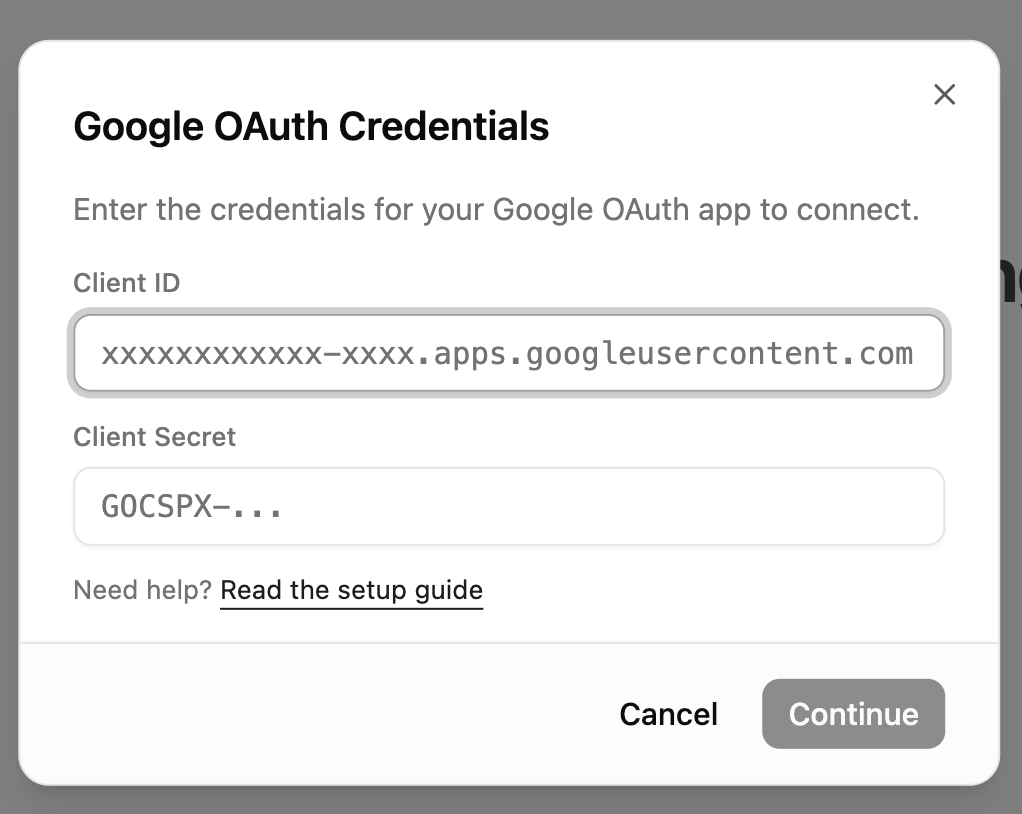
Copy **both values** and paste them into Rowboat when prompted.
feat(oauth): switch Google OAuth from PKCE to authorization code flow with client secret Previously, the Google OAuth integration used a PKCE-only flow (no client secret). This switches to a standard authorization code flow where the user provides both a Client ID and Client Secret from a "Web application" type OAuth client in Google Cloud Console. PKCE is retained alongside the secret for defense in depth. Key changes: - oauth-client.ts: discoverConfiguration() and createStaticConfiguration() now accept an optional clientSecret param. When provided, uses ClientSecretPost instead of None() for client authentication. - oauth-handler.ts: connectProvider() takes a credentials object ({clientId, clientSecret}) instead of a bare clientId. Removed eager persistence of clientId before flow completion — credentials are now only saved after successful token exchange. Renamed resolveClientId to resolveClientCredentials to return both values from a single repo read. - google-client-factory.ts: same resolveClientId → resolveCredentials rename. Passes clientSecret to OAuth2Client constructor and discoverConfiguration for token refresh. - repo.ts: added clientSecret to ProviderConnectionSchema. Not exposed to renderer via ClientFacingConfigSchema (stays main-process only). - IPC: added clientSecret to oauth:connect request schema. Handler builds a credentials object and passes it through. - UI: GoogleClientIdModal now collects both Client ID and Client Secret (password field). Always shown on connect — no in-memory credential caching. Renamed google-client-id-store to google-credentials-store with a unified {clientId, clientSecret} object. - google-setup.md: updated to instruct users to create a "Web application" type OAuth client (instead of UWP), add the localhost redirect URI, and copy both Client ID and Client Secret. Added credentials modal screenshot. Co-Authored-By: Claude Opus 4.6 (1M context) <noreply@anthropic.com>
2026-04-10 00:42:59 +05:30
![Enter credentials in Rowboat](https://raw.githubusercontent.com/rowboatlabs/rowboat/main/apps/docs/docs/img/google-setup/07-enter-credentials.png)
---
## Troubleshooting
**Error after "Authorization Successful"**
If the browser shows "Authorization Successful" but the app then shows an error (e.g. "invalid response encountered" or "response parameter \"iss\" (issuer) missing"):
1. **Check the app logs** (e.g. terminal or dev tools) for the full error. The message there will often indicate the cause (e.g. redirect URI mismatch, missing parameter).
feat(oauth): switch Google OAuth from PKCE to authorization code flow with client secret Previously, the Google OAuth integration used a PKCE-only flow (no client secret). This switches to a standard authorization code flow where the user provides both a Client ID and Client Secret from a "Web application" type OAuth client in Google Cloud Console. PKCE is retained alongside the secret for defense in depth. Key changes: - oauth-client.ts: discoverConfiguration() and createStaticConfiguration() now accept an optional clientSecret param. When provided, uses ClientSecretPost instead of None() for client authentication. - oauth-handler.ts: connectProvider() takes a credentials object ({clientId, clientSecret}) instead of a bare clientId. Removed eager persistence of clientId before flow completion — credentials are now only saved after successful token exchange. Renamed resolveClientId to resolveClientCredentials to return both values from a single repo read. - google-client-factory.ts: same resolveClientId → resolveCredentials rename. Passes clientSecret to OAuth2Client constructor and discoverConfiguration for token refresh. - repo.ts: added clientSecret to ProviderConnectionSchema. Not exposed to renderer via ClientFacingConfigSchema (stays main-process only). - IPC: added clientSecret to oauth:connect request schema. Handler builds a credentials object and passes it through. - UI: GoogleClientIdModal now collects both Client ID and Client Secret (password field). Always shown on connect — no in-memory credential caching. Renamed google-client-id-store to google-credentials-store with a unified {clientId, clientSecret} object. - google-setup.md: updated to instruct users to create a "Web application" type OAuth client (instead of UWP), add the localhost redirect URI, and copy both Client ID and Client Secret. Added credentials modal screenshot. Co-Authored-By: Claude Opus 4.6 (1M context) <noreply@anthropic.com>
2026-04-10 00:42:59 +05:30
2. **Verify redirect URI in Google Cloud Console**: Open [Credentials → your OAuth 2.0 Client ID](https://console.cloud.google.com/auth/clients). Ensure `http://localhost:8080/oauth/callback` is listed under **Authorized redirect URIs**.
3. **Client type**: Make sure you selected **Web application** as the application type. Other types (Desktop, UWP) may not provide a client secret or may handle redirect URIs differently.
---